
High Quality Local Theater – Driving Miss Daisy
By: The Jewish Voice And Opinion Staff
Driving Miss Daisy, by Alfred Uhry, is a work of historical fiction that explores the Jewish experience in Atlanta during the civil rights era from 1948 to 1973. This show, playing at the Bell Theater through August 23, hits close to home. When a bomb detonated inside Atlanta’s Hebrew Benevolent Congregation in October 1958, it felt like it could have been from today’s headlines.
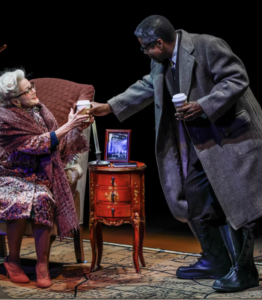
Daisy (Alison Fraser) with Hoke (Bernard Dotson)
The show links discrimination from antisemitism and race, connecting the lives of Daisy Werthan (Southern belle – Alison Fraser) and her chauffeur, Hoke (played by the amazing Bernard Dotson), a Jewish woman and a Black man living in the Jim Crow South. The play was inspired by Uhry’s grandmother and her chauffeur. It reminds us that despite outward appearances, there is an unspoken outsider status based on stereotyping. Hoke’s comment hits home, “A Jew is a Jew to them, folks. Just like light or dark, we all the same…”
A willingness to listen and to share can create strong friendships, lasting bonds, and a heart-warming story.
Southern Charm
The show opens with a car crash, as Daisy, a proud, independent widow of 72, crashes her new 1946 Chrysler into the garage. She is unhurt and blames the car. But her son, Boolie (Abe Goldfarb), realizes it is time that she stops driving, insisting that she is uninsurable. He hires a Black chauffeur, Hoke, as her driver. The pair gets off to a rocky start, but over the next 25 years, the two develop a strong relationship, gradually sharing their families’ histories.
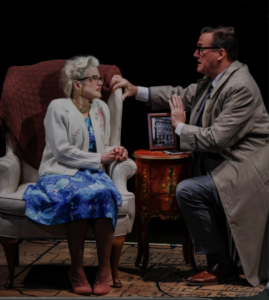
Daisy (Alison Fraser) with Boolie (Abe Goldfarb)
The Werthan family are wealthy assimilated Southern Jews. Daisy’s husband built a successful printing business, which Boolie was running. Daisy stubbornly insists she is a simple person who grew up poor on Forsyth Street, where her family had to count every penny. She was a public-school teacher, a professional, self-sufficient woman who did not want to be viewed as putting on airs. She is frugal, counting the cans of salmon in her pantry, and values morality. She becomes enraged after discovering an empty can in the garbage, but is pleased when Hoke comes to work the next day with a can to replace the one he had eaten.
Hoke worked hard to support his family, but being an older Black man in Atlanta, it was difficult to keep a job. They share a devotion to family. Hoke’s daughter married a Pullman porter and traveled frequently, but he was devoted to his granddaughter, who was the reason he remained in Atlanta. Daisy, though close to her son, dislikes his wife, Florine, whom she views as a social climber who throws lavish parties.
Hoke is soft-spoken and patient, while Daisy is sharp-tongued and opinionated. They both give of themselves, bending over time to become unlikely best friends.
Atlanta Society
Daisy was ignorant of the conditions facing Black people in the segregated South. Shocked when she discovered that Hoke could not read, she taught him to recognize letters. She did not realize that Blacks were forbidden from using the restrooms at white-owned gas stations and got agitated when Hoke pulled the car over to the side of the road and politely explained that he needed to use the bathroom. He went anyway, holding on to the car keys. This was an indication of the gap that remained.
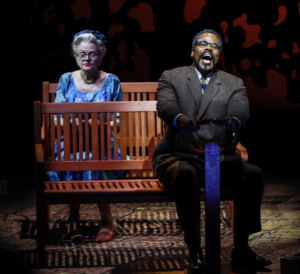
Daisy (Alison Fraser) with Hoke (Bernard Dotson)
After the temple bombing, Hoke shared a painful childhood memory of his father’s friend being lynched, explaining that hatred makes no distinction. The Civil Rights movement was beginning to spread through the South. When Daisy purchased tickets for the Jewish organization’s dinner honoring Martin Luther King, her son refused to go, saying it would hurt business, and suggested that she invite Hoke. She waited until they were outside the venue the night of the dinner to extend the invitation. Society was changing, but not fast enough.

The Performance
Over 120 minutes, the three-person cast brought the story to life, moving swiftly through the highlights of the relationship between Miss Daisy and Hoke. We watch them age together, as Daisy reaches her 90s, she becomes visibly frail, while Hoke, whose eyesight is failing, is no longer able to drive. They built a strong relationship that transcends race, religion, and family. This is a story about resilience, dignity, and the unlikely bond that transforms two lives.
For an enjoyable evening out, see Driving Miss Daisy at the Bell Theater through August 23.

Related Posts
-
 25 Years Later – Come From Away
Posted on Sep 19, 2026
-
 We’ll Meet Again – A Musical – Inspired by a True Story
Posted on Jun 21, 2026
-
 Brandeis Center Attorney and Former Healthcare Compliance Professional to Testify Before Congress on Alleged Anti-Semitic Harassment and Ostracizing in Healthcare Workplaces
Posted on May 18, 2026
-
 My Neighbor Adolf – Haunted by Memories
Posted on May 7, 2026
Tags
Share This


