
My Neighbor Adolf – Haunted by Memories
By Two Sues on the Aisle, Susie Rosenbluth and Sue Weston
My Neighbor Adolf is a dark comedy by writer-director Leon Prudovsky that explores the relationship between a reclusive Holocaust survivor, Plosky (David Hayman), and his new neighbor, a mysterious bearded German, Herr Herzog (Udo Kier). The protagonist, Polsky, is a former chess champion who craves solitude. A Holocaust survivor (we briefly glimpse the number tattooed on his arm), who was once part of a large family. Plosky maintains a minimalistic existence, devoted to routine, including growing black roses, which had been his wife’s favorites.
The movie is set in Colombia in the 1960s, just as Israel was completing a covert Mossad mission to abduct Adolf Eichmann in Argentina.

Plosky (David Hayman) and Herr Herzog (Udo Kier)
When the adjoining property is sold to a reclusive man who seems vaguely familiar, Plosky becomes obsessed with discovering his neighbor’s identity. His new neighbor’s characteristics and habits remind him of Hitler (whose body had never been recovered, despite reports of his 1945 suicide in Berlin).
My Neighbor Adolf is a bittersweet, heartwarming drama. It shows our ability to overcome loss and secrets from the past.
Obsession and Doubt
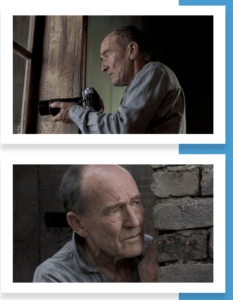 Plosky had met Hitler briefly at a chess tournament and clearly remembers his eyes. When he notices the similarity with his neighbor’s eyes, he begins surveillance, looking for other similarities. Plosky is confident that there is something unusual about his neighbor. He becomes convinced that he might be Hitler, and reports it to the Israeli embassy.
The bureaucrats dismiss him as a delusional survivor, deeming the tip unreliable. This drives Plosk to explore the identity of his mysterious neighbor. He begins gathering documentation and photographs that will support his case, delivering irrefutable evidence. But, Plosky is thrown out of the embassy again.
Polsky is kept at arm’s length from his neighbor by an efficient German lawyer, Frau Kaltenbrunner (Olivia Silhavy), who prevents the men from speaking. Tension builds when she informs Polsky that the garden where the roses are growing is on his neighbor’s property, and insists on moving the fence. Polsky needs to get through to tend to the roses, which creates a reason for the two men to interact. They connect through love of chess. But secrets from their pasts keep them distant.
Prudovsky is the grandson of a survivor, described as ‘a bitter, short-tempered, anxious lady. She rarely laughed, she was constantly tense, looking like always waiting for the next blow. Like many other Holocaust survivors, she could never recover from the trauma, reconcile with the loss, or get over her enmity towards Germans.’ Polsky’s character echoes his grandmother’s distrust of the world.
A Powerful Movie
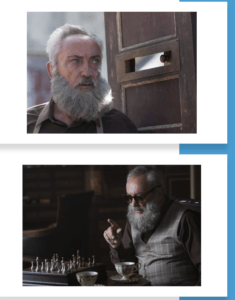 The exceptional casting and acting made this movie resonate. The well-constructed setting provides an element of realism and believability. Polsky’s stark existence and the simplicity of his life feel appropriate. Until his neighbor moved in, his only visitor was the mailman, delivering the newspaper through an opening in the fence. To maintain the connection with his pre-Holocaust life, he disconnected from society. This gives us an understanding of the Polskys’ mental health, his brilliant mind, like his land, goes fallow.
Polsky comes to life when he is presented with a challenge of proving the identity of his neighbor. He becomes convinced that his worst fear has come true, Hitler is alive and living next door. My Neighbor Adolf explores what can happen when you find yourself becoming friends with the person you fear most.
This is a powerful story, which questions the accuracy of our power of observation and willingness to quickly jump to conclusions. More importantly, it creates space for reconciliation. My Neighbor Adolf leaves us with hope, recognizing the value of human connections and our ability to move beyond the past.
Two Sues on the Aisle bases its ratings on how many challahs (1-5) it pays to buy (rather than make) to see the play, show, film, book, or exhibit being reviewed.
My Neighbor Adolf received 4 Challahs
Runtime: 93 minutes

Related Posts
-
 High Quality Local Theater – Driving Miss Daisy
Posted on Aug 16, 2026
-
 Discovering a Hidden Past – For the Love of a Woman
Posted on Jul 2, 2026
-
 Tarnished American Dream in a Brilliant Death of a Salesman
Posted on May 8, 2026
-
 The Reservoir Supplies a Wellspring of Hope for Addiction
Posted on Mar 29, 2026
Tags
Share This


