
The Vienna Lessons: A Hypothetical Meeting’s Real Jewish Angle
By Two Sues on the Aisle, Susie Rosenbluth and Sue Weston
There’s no mention of a Jewish tie between the careers of composers Wolfgang Amadeus Mozart and Ludwig Van Beethoven in Jack Canfora’s The Vienna Lessons, now playing at the New Jersey Repertory Company in Long Branch through June 28 —but there could have been. It would have been as historically accurate as anything else in this fascinating-to-think-about play.
Imagining meetings and conversations between historic personalities is a tried-and-true theatrical device, regardless of whether or not those interactions ever really took place. Mr. Canfora is well within that tradition, envisioning what might have happened if, in 1787, a gifted, confident 16-year-old Beethoven had approached the financially struggling, yet recognized maestro Mozart, and asked for lessons.
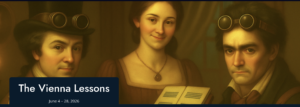
It’s not as though no one else ever came up with the idea that the 31-year-old Mozart and the brash teenaged Beethoven could have met. Evidence exists that, for a few weeks in early spring 1787, they were actually both in Vienna, to which Mozart had fled from Salzberg six years earlier. Beethoven arrived in the then-undisputed capital of the music world from his home in Bonn. His patrons wanted the relatively unknown piano prodigy to study with Mozart, who was, by then, a well-established composer, pianist, violist, organist, conductor, and teacher. Beethoven had been only 11 years old when critics in Bonn compared him to Mozart.
At least one historian, Mozart’s biographer, Otto Jahn, wrote in 1856 (when all the principals were dead and gone) that he had it “on good authority” that, during those weeks, Beethoven played a recital attended by Mozart. Sufficiently impressed, the maestro supposedly asked the teenager to play for him privately, but Mozart thought the selection Beethoven chose was “a studied showpiece.” Beethoven, noticing Mozart’s “cold expression of admiration,” begged for a theme for improvisation, and “inspired by the master he revered so highly, played in such a manner as to gradually engross Mozart’s whole attention.” According to Jahn, Mozart told bystanders, “Mark that young man. He will make a name for himself in the world.”
Photos by Andrea Phox
At that point, Mozart might have agreed to take the young man on as a pupil, but in mid-April 1787, Beethoven left Vienna and returned to Bonn to see his dying mother—and possibly to protect his two younger brothers from their father. By the time Beethoven returned permanently to Vienna in 1792, Mozart had passed away at the age of 35.
Difficult Roles
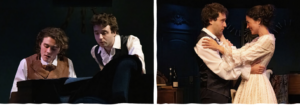
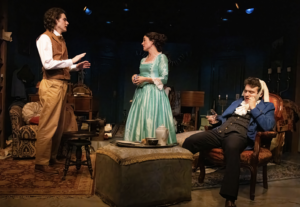
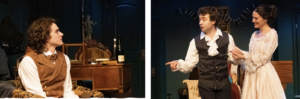
Mr. Canfora’s assumption is that, in 1787, Mozart would still be the rude, bordering-on-obnoxious, man-child, who just happens to be a genius, drawn by Peter Shaffer in his magnificent Amadeus. In Long Branch, Jesse Kodama does his best, prancing and clowning until he sits down at the piano or discusses music, when hints of the hidden virtuoso shine through. It is an almost impossibly difficult role.
As Beethoven, Quentin Chisolm has an easier time. Tall and almost prince-like, he is a smoothly believable ambitious-but-respectful young man, awed at being in his idol’s presence yet absolutely certain of his right to be taken seriously by him.
While these two are thrust into the roles of teacher and student, Mr. Canfora makes clear they are engaged in something more. Mozart represents the apotheosis of elegant, balanced Classicism. Musicologists insist he was also knocking on the door of Romanticism. Beethoven, with his dramatic intensity and surprise, not only opened that door, he tore it down. Watching them discuss music while they play and improvise, Mr. Canfora’s audience can believe it’s happening right before their eyes.
Photos by Andrea Phox
Witnessing it all with them is Mozart’s wife, Costanza, played by Sandy Clancy as a head-over-heels-in-love young woman who never doubts her husband’s genius but wishes he would earn more money. Her flirtation with Beethoven seems only half-heartedly maternal—but it could be she just wants to be sure he’ll keep paying for his lessons.
History and Influence
Amadeus depicted Mozart as a genius morally undeserving of G-d’s gifts, and pitted him against Antonio Salieri, an older, more courtly counterpart, whose curse was to be wise and talented enough to recognize that the younger man would live forever through his music—while so many others who were esteemed in their time would fade from memory. The Vienna Lessons presents two towering figures not only jousting with one another but learning as they go, each aware of the other’s prowess and his own.
But more than music links these two. Like all of us, they are prisoners of their past, haunted by abusive musician fathers who, in the end, had to recognize that their sons would outshine them. The difference in age between 16 and 31 is sufficient to make it reasonable when Mozart pulls rank on Beethoven, but had they lived to be older colleagues, they might have been able to console one another.
Although many historians don’t believe an actual meeting between the two composers ever occurred—and forget about a series of regular lessons that forged anything like a relationship—there is no question Beethoven was greatly influenced by Mozart. The younger man studied Mozart’s scores closely, based several sets of variations on his themes, and used Mozart’s work as a launching pad to revolutionize music. Beethoven—like so many others—considered Mozart’s Requiem the highest expression of religious music, and decades later, near the end of his life, said openly he would remain a devoted admirer of Mozart “until the day of my death.”
Photos by Andrea Phox
There is no Jewish angle to The Vienna Lessons, but as long as Mr. Canfora was hypothesizing, it might have been interesting to include mention of the historically accurate debt Mozart owed members of Vienna’s 18th-century Jewish community. Baron Raimond von Plankenstern, a wealthy landlord and patron of the arts, sheltered Mozart during many of the composer’s financial crises. A convert to Catholicism—whose Jewish background was an open secret in Vienna—he provided space for Mozart’s concerts and stood as the godfather for one of his and Constanza’s sons. Fanny von Arnstein, a prominent Jewish salon hostess and pianist in Vienna, also fostered Mozart’s work.
In addition, Mozart’s arguably greatest operas, The Marriage of Figaro, Don Giovanni, and Cosi Fan Tutte, were created in conjunction with the composer’s most famous librettist, the Jewish Lorenzo Da Ponte (born Emanuele Conegliano).
It’s possible, despite the era’s prejudices, Mozart’s ties to the Jewish community, including, evidence shows, many Jewish friends and supporters, served as another influence on the young Beethoven, whose own Jewish connections went on to include collaborators and publishers. In 1816, Beethoven set the poetry of the openly Jewish writer and physician, Alois Isidor Jeitteles, for his only song cycle, An die ferne Geliebte (To the Distant Beloved). Most of Beethoven’s final compositions, including his Missa Solemnis as well as his late quartets and sonatas, were published by the family of Adolf Martin Schlesinger (born Aaron Moses Schlesinger). Like Mozart, Beethoven, too, was a frequent guest at Mrs. Arnstein’s salons.
The Synagogue’s Cantata
Most interesting is Beethoven’s 1825 decision to accept the request by the Viennese Jewish community to compose a cantata for the dedication of the new Stadttempel synagogue. He studied ancient Hebrew music, Handel’s oratorios based on Hebrew texts, and the Kol Nidrei itself for the project. Although the commission ultimately went to Franz Schubert, many music scholars believe Beethoven’s engagement with the Kol Nidrei service deeply influenced his masterpiece, the String Quartet No. 14 in C-sharp minor, Op 131, reportedly the composer’s own favorite of his late works.
It is said that, upon listening to a performance of this quartet, Franz Schubert remarked, “After this, what is left for us to write?” To which the composer Robert Schumann added, it had a “grandeur that no words can express.”
It wouldn’t have taken a great leap of faith for this joint association between Mozart, Beethoven, and their Jewish connections, to be included in The Vienna Lessons, especially when you think about how Jews, despite our infinitesimally small representation in the world’s population, touched the arguably two greatest composers of all time.
Related Posts
-
 The Catskills 1969 A Time of Change – Broadway Bound
Posted on May 21, 2026
-
 Almost 90 Years Later the Issues Still Resonate – My Lord, What a Night
Posted on May 15, 2026
-
 Small Makes a Big Impression – George Street Playhouse
Posted on Apr 23, 2026
-
 How My Grandparents Fell in Love: Romance Blooms in Catastrophe’s Shadow
Posted on Mar 16, 2026
Tags
Share This


