
Almost 90 Years Later the Issues Still Resonate – My Lord, What a Night
By Two Sues on the Aisle, Susie Rosenbluth and Sue Weston
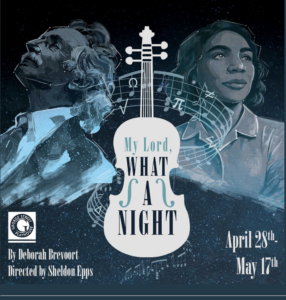
Unlike many plays about encounters between famous people—for which there is no historical evidence of them ever taking place—My Lord, What a Night, by Deborah Brevoort, showing at The George Street Playhouse, through May 17, is based on a real meeting in 1937 between the groundbreaking, adored African-American contralto Marian Anderson and the brilliant, renowned German-born Jewish theoretical physicist Albert Einstein. Their almost-chance crossing of paths led to an 18-year friendship anchored in their mutual love of music and shared opposition to racial and religious prejudice.

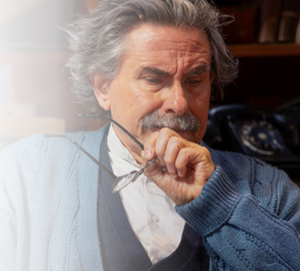
As the play shows, Einstein (played with just the right amount of wit and understated poignancy by Anthony Cochrane), who had escaped Nazi Germany and European antisemitism, met Anderson (portrayed by Rashidra Scott as a simultaneously grand and frightened artist) right after the diva’s well-received concert at Princeton’s McCarter Theatre. She had been scheduled to stay at the Nassau Inn but was refused a room because of the color of her skin. Horrified at the treatment to which she was subjected, Einstein, who had attended the performance, takes her to his home on the Princeton campus, where he had been recruited to teach at the Institute for Advanced Study.
The play begins as they arrive in his elegant sitting area, perfectly designed by Meghan Raham, where crumpled papers cover every surface, and his violin sits on the floor. When Anderson, who is used to racism below the Mason-Dixon Line, expresses surprise at her treatment “in Princeton,” where she expected more tolerance and acceptance, he replies, “The people of Princeton are not enlightened … they are wealthy. There is a difference. Unfortunately, your country makes the mistake of equating the two.”
Avoiding or Attracting Scandal
Her presence in his home causes a media frenzy presumably because of her stardom and his notoriety as a brilliant Nobel Prize winner and defier of social norms—and it prompts visits from Abraham Flexner (Mitch Greenberg), the founding director of the institute, and Mary Church Terrell (Gayle Samuels), the Washington, DC-based American civil rights activist, journalist, teacher, and one of the first African-American women to earn a college degree. The well-meaning but terrified Flexner, concerned about reputational damage to the institute that could be incurred by the scandal of a single Black woman spending the night in the home of the then-widowed white professor, offers to escort Anderson to the local “Colored YMCA.” Terrell, who traveled to New Jersey to see Anderson perform—but was not admitted because the concert’s venue was for “whites only”—wants to persuade the contralto to allow the incident at the Nassau Inn to rally attention to the ill treatment accorded African Americans.

Both scenarios are rejected by Einstein and Anderson—he because her leaving might suggest he condoned racism, she because drawing attention to herself for anything but her music is anathematic—and might make things difficult for her manager, the renowned Sol Hurok (born Solomon Izrailevich Gurkov, another Jewish immigrant whose name became synonymous with promoting the most talented artists in the world regardless of their race, color, or creed) and badly affect her upcoming concert tours.
When Ms. Scott sings, it is easy to understand why Einstein adores her voice, especially for Schubert, and she relishes the Gospels she was raised with. The two recognize the connection between science and music.
“The great composers don’t create,” he tells her. “They listen. And then they write down what they hear. The great scientists do the same thing.”
Anderson gives him her take on the comparison: “You can’t sing a song until you feel it. No matter how hard you try, the song cannot be grasped. When that happens, you just have to turn away. But then, sometimes, you’ll have a flash of understanding. That song that you’ve been unable to reach will suddenly become clear. In an instant, it’s yours. And you can sing it.”
Character Study
The talented cast breathes life into the rich dialogue, lending authenticity that places the audience in the room with the two larger-than-life icons as the drama unfolds. Einstein pretty much agrees with Terrell, and Anderson understands Flexner’s dilemma, but the professor and the artist stick to their guns, and the singer stays in his home, an arrangement she followed for years every time she found herself in New Jersey.
If My Lord, What a Night were allowed to devolve into the sappiness of a romance—real or imagined—Einstein and Anderson would epitomize the opposites-attract trope. He is disheveled, she prim and proper. He would love to speak to the press, especially because he knows his name carries weight—and nothing would give this former victim of prejudice and persecution more pleasure than the opportunity to rail against those forces in his adopted homeland. Genius in physics means nothing, he says, if he cannot use his platform to defend human dignity. In the hands of director Sheldon Epps and the exceptionally fine cast, Ms. Brevoort’s lines don’t sound cloying at all – but rather, heartfelt and determined.
Anderson, on the other hand, who will sing anywhere she is invited, abhors the very idea of taking a public stand for a cause. Einstein and Terrell see the need to fight for change; Flexner and Anderson fear the consequences. The play explores the confluence of events that force even the most reticent to recognize the necessity to act.
It might be easy to pigeonhole Flexner as nothing more than an elegantly dressed, diplomatically minded pencil pusher, providing the voice of caution and pragmatism, trying not to make waves. However, it was he—despite Princeton’s record of hiring very few Jewish faculty—who recruited not only Einstein but many other Jewish-European academics to the Ivy League school, thus saving them from the ranks of millions of victims of the Nazis.
Terrell is not a publicity hound for herself. Ms. Samuels renders her a small, slight, dignified force of nature, a powerhouse and tireless advocate for change who, when faced with having to take “no,” switches gears to try another tack in the effort to get to “yes.” Her goal: To get public figures to lend their support to ending segregation, and Einstein is only too willing to join her. She was a founder of the NAACP, and he was one of its first members.
The Same Issues
If the first act of the play deals with generalities, the second, which takes place two years later, in 1939, delves into specifics, with higher stakes that make Einstein’s and Terrell’s natural tendencies the only path despite Anderson’s and Flexner’s efforts to avoid national headlines. The Daughters of the American Revolution have denied Anderson the right to sing at their Constitution Hall, and Einstein discovered the Nazis, using his work, have achieved nuclear fission, intending to create the most destructive weapon in history. Einstein’s dilemma: Knowing the Germans, he has no doubt that if they develop it first, they will use it. Einstein and Flexner have the connections to get this information to American President Franklin D. Roosevelt, but then, the U.S. might use it, too.
Interestingly, those very same connections are the ones that could shame the DAR into opening the hall to Anderson, a path they might take—until the singer comes up with an idea that changed history and the civil rights movement forever.
When My Lord, What a Night was written some ten years ago, antisemitism was nowhere near the issue it is today, especially on American campuses, making Ms. Brevoort’s concept more timely than perhaps she imagined. In her play, Flexner is afraid that Einstein’s activism, drawing attention to race and religious issues, will disrupt the fragile relationship between Jewish professors at the institute and the Princeton Administration that wants to impose quotas limiting the number of Jewish students admitted to their campus. Einstein, however, draws a direct parallel between the rising tide of Nazism in Europe and the Jim Crow laws in America. He views the persecution of Jews and the systemic racism against Black Americans as the same “evil” aimed at different targets.
The evil of bias—the voices of antisemitism, masked these days as anti-Zionism and anti-Israel hatred—fill today’s headlines. On college campuses, hatred based on ignorance creates persecution across America. Einstein (an early believer in Zionism), Anderson, and, hopefully, Ms. Brevoort would see this powerful play as a wake-up call.
Related Posts
-
 State Theatre New Jersey Presents – An Evening of Alton Brown
Posted on Oct 22, 2026
-
 A Powerful Story – MIDNIGHT
Posted on Oct 16, 2026
-
 80 Outstanding Jewish Students from 12 Countries Complete Birthright Israel Summer Fellowship
Posted on Aug 12, 2026
-
 The Vienna Lessons: A Hypothetical Meeting’s Real Jewish Angle
Posted on Jun 14, 2026
Tags
Share This


