
A Walk on the Moon: The Summer of ’69 as Metaphor
By Sue Weston and Susie Rosenbluth, Two Sues on the Aisle
Pamela Gray has gotten a lot of mileage out of A Walk on the Moon, her delightful, not-so-sugar-coated memory of Jewish life in a Catskills bungalow colony during the historically significant summer of 1969. First a 1999 Miramax film and then a play with some cute tunes, it is now a full-blown musical (thanks to composer and lyricist AnnMarie Milazzo), still using the year the Apollo 11 launched Neil Armstrong as a metaphor for the line marking the end of many 1950s assumptions—that childhood continued into teenage years, that women’s lib lived mostly in the mind of Betty Friedan, and marriage meant happily ever after.
In Ms. Gray’s hands, the 1969 moon landing meant the impossible had become reality.
The storyline has not changed. As television crews prepare to showcase the first men landing on the moon, the Kantrowitz family arrives for its annual summer sojourn in the Borsht Belt. Pearl (played by the talented Talia Suskauer) is a still-attractive, dreamy-eyed, devoted wife to her charmingly hard-working husband, Marty (Max Chernin), a once-aspiring scientist who has settled for being a TV repairman, and mother to young Danny (Leo Caravano at the performance we caught) and 15-year-old Alison (Sophie Pollono, who solidly nails the teenager poised between adolescent innocence and emerging sexuality).
Rounding out the party is Marty’s mother, Lillian (Andrea Burns), a quintessential Jewish Bubby, except for two small details—she reads tea leaves and, as a single mother, knows that working outside the home to feed and clothe your children doesn’t have anything to do with The Feminine Mystique.
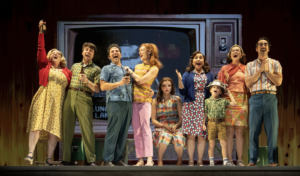
Photo by Joan Marcus
Not Quite the Garden of Eden
This Garden of Eden works according to some very set rules that provide a walk down memory lane for those who either experienced them personally or have read enough about them. The year may be 1969, but for these middle-class, Brooklyn-based Jewish families—sufficiently financially comfortable to afford the bungalow but not wealthy enough to enjoy the luxury of a hotel for the parents and sleepaway summer camp for the children—it might just as well be the 1950s. A tie-dyed blouse—to say nothing of long-haired hippies—representing unwelcomed counterculture. They’ve heard about Women’s Rights and Betty Friedan on the news, but these iconic influences have not affected their lives—yet.
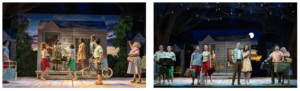
Photo by Joan Marcus
The wives and children stay in the bungalow colony for the whole summer while the husbands commute, showing up on Friday afternoons before Shabbos and competing among themselves for who made the best time from the city to the mountains. Once the men leave on Sunday night, the women return to gossiping while playing mahjong and enjoying the colony’s amenities, such as sampling the wares of Shimmy the Pickle Man with his legendary garlic sours and trying on shirts brought by the Blouse Man. On Friday afternoons, the cycle repeats, with the women prettying themselves up, preparing for the return of their husbands.
All this while others around the country were burning draft cards, flags, and bras and celebrating Israel’s miraculous victory in the 1967 Six-Day War. Small wonder, Pearl poses the rhetorical question: “Ever feel like the whole decade’s gone by and we haven’t been in it?”
Men Not Their Husbands

Photo by Joan Marcus
Which brings up the subject of the snakes in this Garden. For Alison’s family, it could be a boy with a guitar (adorable Oscar Williams), who fancies himself the “Big Jewish Hendrix.” Alison, eager to save the world, especially if she can do it to music, meets him after stalking off in a huff because her parents left her record player at home in Brooklyn. She knows more about music than Ross does—but he knows there’s going to be a music festival in nearby Woodstock.
For Pearl, it’s Walker Jerome (soft-spoken, pitch-perfect Sam Gravitte), the long-haired local who has replaced the former, longtime, Jewish blouse man. A non-Jewish free spirit who is working mostly to fund a trip to San Francisco, Walker talks Pearl into buying a tie-dyed blouse, which becomes a cross between a personal statement of style and the desperate hope her husband will like something new and different. When Marty doesn’t, the audience knows it has nothing to do with the design per se but, rather, his perceived need for tradition and routine—Entenmann’s black-out cake, not Ebinger’s; a lovely floral blouse, not one whose riotous colors bleed into one another.
Marty’s yearning for the familiar conflicts with Pearl’s lament for her lost youth—and sends her on a strange path to seek fulfillment.
No Villains
The realization that there is no way to change the past but, rather, only a determination to build a better future is what gives A Walk on the Moon its powerful, though understated conclusion. Pearl and Marty each have sacrificed dreams, but if the commitment is strong enough, there is a path to forgiveness. In this, the vision of the new decade—the 1970s—serves as another of Ms. Gray’s metaphors: the willingness to try again and the refusal to let what’s good in life pass you by.

Photo by Joan Marcus
In fact, A Walk on the Moon has no villains. Rather, its generosity of spirit—thanks to Ms. Gray and Ms. Milazzo—shines in numbers such as Pearl’s cry of pain, “Out of This World,” expressed directly to Mr. Armstrong and her “Not Willing to Lose,” in which she admits she doesn’t know how to save her marriage—but she really wants to.
Perhaps the most poignant and memorable song comes in the second act, when Marty proves that being a good father not only pulls every heartstring but is also sexier than any devil-may-care impetuous seduction could ever be. He sings “We Made You” to Alison when he learns she has figured out her conception was the accident it probably was. Through this beautifully touching ballad, he successfully convinces her how wanted she was—and is. And Alison is not the only one moved by him—so are Pearl and the audience.
Destination Broadway
Watching a show mature, from a regional theater to off-Broadway, is an amazing journey. We saw A Walk on the Moon at The George Street Playhouse in New Brunswick, New Jersey, in 2022. Four years later, with expanded and reinvigorated music by Ms. Milazzo and lyrics by her and Ms. Gray, this show is captivating. This revitalized production benefits from an all-star cast, amazing set design, and credible dialogue, complete with Brooklyn-accents and authentic Jewish expressions.
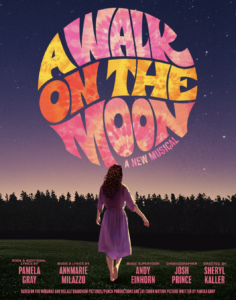
A Walk on the Moon brings the summer of ’69 into focus, a time of unrest balanced by American pride for winning the space race, discontent with the war in Vietnam colliding with newfound sexual freedom and the struggle for racial equality, and all these forces marking the end of one decade and, as it does for Pearl and Marty, prompting facing the next with anticipation and hope.
We were lucky enough to participate in a talk-back after the show with Ms. Gray and one of her inspirations, Susan Etess, the granddaughter of Jennie Grossinger, as they fondly recounted their memories of the Jewish Catskills. Visitors to the Borscht Belt should take their suggestion to look at the Catskills Historical markers, and those who venture into Manhattan should make it a point to see A Walk on the Moon.
Two Sues on the Aisle bases its ratings on how many challahs (1-5) it pays to buy (rather than make) to see the play, show, film, book, or exhibit being reviewed.

Five Challah Rating
Related Posts
-
 A Powerful Story – MIDNIGHT
Posted on Oct 16, 2026
-
 25 Years Later – Come From Away
Posted on Sep 19, 2026
-
 We’ll Meet Again – A Musical – Inspired by a True Story
Posted on Jun 21, 2026
-
 A New York City Classic – West Side Story
Posted on Jun 5, 2026
Tags
Share This


