
How My Grandparents Fell in Love: Romance Blooms in Catastrophe’s Shadow
By Sue Weston and Susan Rosenbluth – Two Sues On The Aisle
[Updated March 2026]
The kernel of truth underlying Cary Gitter’s and Neil Berg’s new musical, How My Grandparents Fell in Love, is that embedded within the particular shines the universal. Now enjoying its premiere at the New Jersey Repertory Company in Long Branch, the work is about Charlie (Harris Milgrim), a Jewish-American émigré who returns to the bustling city of Rovno (Równe) to find his basherte. Were it not for the time in which this piece is set—1933—it could be about the patriarch of any of the millions of immigrant American families who trace their roots to towns across the sea.
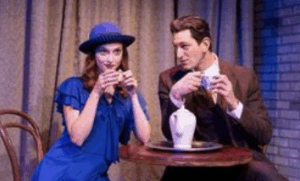
Photos by Andrea Phox
This one rises above any of the now-familiar, boy-meets-standoffish-girl-who-has-to-be-convinced-of-how-special-he-is tropes because the story’s tension lies in the audience’s recognition that, in 1933, all of Europe—and in particular, the Eastern European countries’ large Jewish communities—stood on the precipice of the abyss. Although the young woman, Chava (Becca Suskauer, who also plays the couple’s granddaughter), doesn’t know it, her decision whether or not to follow the young man will determine not only her own life-or-death future but also that of the generations of Jewish children she and her husband-to-be will leave to the future.
In this, “How My Grandparents Fell in Love” is an existential cautionary tale, warning of the importance, especially for Jews, always to keep eyes and ears open to the nuances, hints, and details signaling when it’s time to leave; always to maintain the necessary documents to facilitate the departure; and always to harbor, somewhere in the back of the mind, Plan B.

Rovno, located just west of the interwar border between Poland and the former Soviet Union, is an ideal setting for this two-actor piece. In 1933, some 25,000 Jews (about 40 percent of Rovno’s population) called the then-Polish city home. It didn’t become part of the USSR until the Soviet invasion of Poland in 1939, and when German troops invaded in 1941, it fell to the Wehrmacht. By the end of the war, an estimated 23,000 Jews from Rovno had been killed, most of them in the ghetto established by the Germans and run in conjunction with the Ukrainian police.
Superb Performances
Of course, in 1933, neither Charlie nor Chava could know this was going to happen, and one of the Sues wished Mr. Gitter had taken those in the audience who might be as clueless as the young couple into consideration. However, for those who understand exactly what the time and place mean, Mr. Berg’s pleasant, serviceable score is well suited to the piece.
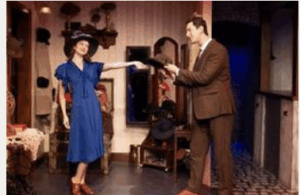
Photos by Andrea Phox
Both Sues, however, agreed that the performances by Mr. Milgrim and Ms. Suskauer were superb. Under the direction of SuzAnne Barabas, music supervisor Matthew Lowy, and choreographer Jordan Ryer, their lyrical voices, delightful dance numbers, and altogether charming personas made Charlie and Chava winning and relatable. Jessica Parks’ imaginative set design works beautifully in the NJ Rep’s captivating theater.
For those as yet unfamiliar with the NJ Repertory Company, How My Grandparents Fell in Love is a wonderful way to get to know this gem of a theater and its founders, Ms. Barabas and her husband, Gabor, who, since 1997, have taken as their mission presenting new works. This means audiences at the Jersey Shore can enjoy a rare opportunity: the chance to see new theatrical pieces—many of them of particular Jewish interest—in a nearby venue with plenty of parking.
Two Sues on the Aisle bases its ratings on how many challahs (1-5) it pays to buy (rather than make) to see the play, show, film, book, or exhibit being reviewed.
How My Grandparents Fell in Love received 4 Challahs
Final performance will be on August 10
How My Grandparents Fell in Love arrives in New York for a limited engagement at 59E59 Theaters (Theater E), March 17 – April 18, 2026.

Four Challah Rating
Related Posts
-
 A Beat of Our Own – Makes a Cultural Connection
Posted on Oct 23, 2026
-
 Grounds for Sculpture – New Instillation Invites Viewers to Contemplate the Multifaceted Nature of Time
Posted on Sep 23, 2026
-
 Heathers the Musical – Future Cult-Classic Takes the Theater by Storm
Posted on Sep 11, 2026
-
 The 25th Annual Putnam County Spelling Bee – BRILLIANT and FUNNY
Posted on Aug 3, 2026
Tags
Share This


