
Yiddish Theater and the American Jewish Experience – Immigrant Songs
By The Jewish Voice and Opinion Staff
Immigrant Songs: Yiddish Theater and the American Jewish Experience, produced by the Milken Archive of Jewish Music, is a documentary about Jewish immigrants contributions to American culture, exploring the Yiddish roots of comedy, music, and drama. Speaking Yiddish was once considered shameful, a sign of a greenhorn, a recent arrival from the old Country. Yiddish almost became extinct, with the Holocaust eliminating half the Yiddish speakers from Europe, while American immigrants assimilated into American culture. Now, Yiddish is making a revival, offering the younger generations a connection to their Jewish identity.
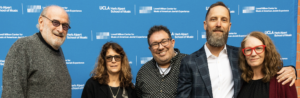
The creative team: Larry Lesser (consultant), Faith Ginsberg (editor), Barak Goldman (co-writer, co-producer), Jeff Janeczko (director, co-writer, co-producer), Nikki Parker Hayes (co-producer)
History of Yiddish Theater
Yiddish theater began in Eastern Europe, with Purim shtick, amateur performances, where people dressed up and performed silly skits. In the late 1800s, groups like the Broder Singers began performing Yiddish songs and short comedic sketches about daily life. They became actor-singers with costumes and make-up, who performed in coffee houses and taverns. Avrom Goldfaden, a failed businessman, considered the “Father of Yiddish Theater,” collaborated with the Broder Singers, expanding their sketches into full-length musical plays.
In America, Boris Thomashefsky was instrumental in bringing Yiddish theater to Second Avenue in New York. He owned and managed several theaters and later became an actor. Thomashefsky is known for bringing translations of the classics to the Yiddish theater and developing melodramatic musical theater. Yiddish theater was popular, considered to be bolder, more intellectual, and more emotionally raw than Broadway at that time, with Yiddish actors bringing an intensity to their roles.
When immigration from Eastern Europe slowed down due to quotas, the Yiddish theater began to fade. At the same time, children of immigrants had become English speakers and began moving away from the Lower East Side.
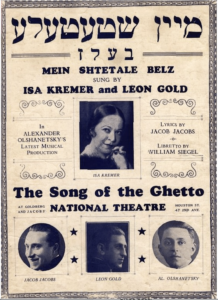
Sheet music cover for Mayn Shtetele, Belz by Alexander Olshanetsky and Jacob Jacobs.
Resurgence of Yiddish Theater – The National Yiddish Theatre Folksbiene (NYTF) was founded in 1915 and is still active. NYFT may be best known for their Yiddish-language production of Fiddler on the Roof (Fidler Afn Dakh), a popular performance. Many felt a connection with the original production, even though it was never actually performed in Yiddish. Something about seeing performances in Yiddish feels right, and provides a connection to their Jewish heritage.
NYFT is led by Artistic Director & Composer, Zalmen Mlotek, a world-renowned conductor and pianist mentored by Leonard Bernstein. Mlotek frequently arranges and “reconstructs” lost Yiddish scores to make them viable for modern audiences. Noteable performances include Hannah Senesh in 2025 and The Sorceress in 2019.
Commentary and Comments
The documentary, Immigrant Songs, provides insights from more than 20 musicians, scholars, and actors. Their wisdom and experiences brought the roller coaster ride of the Yiddish theater to life and made the story relatable. The movie begins with a Yiddish vaudeville act, “Hu Tsa Tsa,” performed by Bruce Adler, bringing a hint of nostalgia, with bits that are still silly-funny. The film’s focus is relatability, including the most memorable music of the Yiddish stage. Bei Mir Bistu Sheyn, which was recorded in 1937 by the Andrews Sisters in a swing version, and Rozhinkes mit Mandlen” (Raisins and Almonds), composed by Avrom Goldfaden.
We enjoyed this short (46-minute) journey into the history of the Yiddish theater. This connection is especially important, as each generation becomes more distant from our European roots, and our cultural identity is less defined. Yiddish becomes a key connection, and the documentary offers a historical perspective on how the Jewish immigrants helped shape theater and continue to contribute to American culture.
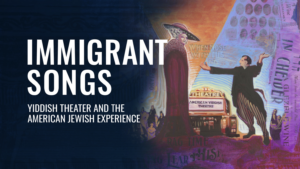
Episode Two will take a deeper look at the composers, detailing their most important songs and productions and placing their work in the broader cultural context of their time.
Founded in 1990 by Lowell Milken, the Milken Archive of Jewish Music: The American Experience is an initiative of the Milken Family Foundation dedicated to preserving, disseminating, and deepening public understanding of music in the American Jewish experience. Covering 350 years with an Archive of 600+ musical works and 180+ oral histories. They produced extensive essays, biographies, and short documentary films available at milkenarchive.org.
Related Posts
-
 Hannah Senesh – A Light in a Period of Darkness
Posted on Dec 30, 2025
-
 The Road Between Us: The Ultimate Rescue – A Documentary of Epic Proportions
Posted on Oct 21, 2025
-
 See, Hear, and Feel the Words of Elie Wiesel — Elie Wiesel: Soul on Fire
Posted on Sep 2, 2025
-
 50 Years after Vietnam – Rolling Thunder Rock-documentary
Posted on Aug 22, 2025
Tags
Share This


