
Family Fun on the Jersey Shore – Jenkinson’s Aquarium, Point Pleasant Beach
By The Jewish Voice and Opinion Staff
Jenkinson’s Aquarium, Point Pleasant Beach, is open year-round, providing a family-friendly environment with education on marine life and conservation to ‘Inspire a Sea of Change’ since 1991. The aquarium is designed as a space where young children can wander and explore. There are large viewing windows at children’s eye level, and exhibits have a child-sized cut-away allowing small visitors to get a closer look.
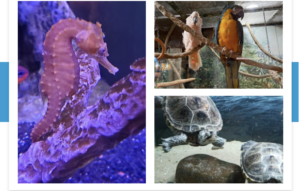
Jenkinson’s Aquarium offers an authentic NJ experience, a mix of local and exotic animals in their habitats. The space is divided into two floors. The downstairs is dimly lit, with soft music welcoming visitors with a warm embrace. Drawn to the large tanks, covering the outside walls, visitors will see large fish, sharks, and rays gliding by effortlessly. In the center is a pond with turtles, surrounded by a raised walkway. There are smaller tanks that challenge older visitors to find the small frogs and lizards, many of which blend into their surroundings. Visitors will be captivated by the tanks filled with jellyfish, seahorses, and other aquatic creatures of all sizes and shapes.
The second level is light and bright, a viewing area for the seal and shark feedings, a supervised Touch Pool, with crustaceans native to New Jersey waters, such as spider crabs, horseshoe crabs, pencil sea urchins, sea stars, and whelks (sea snails). Around the corner is the Rainforest habitat with monkeys, Wally the Sloth, and colorful birds, including two blue-and-gold macaws, Poncho and Bluebeard, and a Moluccan cockatoo, Louie.
Tikkum Olam – Repairing the World
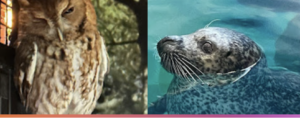
The Aquarium provides a home for creatures who were injured and unable to return to the wild, like Ace, a sea turtle who was stranded in New England and suffered frostbite. Lefty and Red are visually impaired screech owls, and Noelani is a visually impaired harbor seal who shares a habitat with another seal that has lost one flipper. It’s fun to watch the seals swimming around, playing, and to attend a scheduled feeding session where educators share information. Did you know that harbor seals can hold their breath for up to 30 minutes?
The aquarium is part of the Florida Reef Tract Rescue Project, dedicated to rescuing, housing, and propagating Florida corals. Coral is an invertebrate animal with a calcium carbonate skeleton (their bright colors come from the plants living in them).
Jenkinson’s is part of The ReClam the Bay Upweller, a partnership habitat with the aquarium and the ReClam the Bay organization, which showcases the importance of clams, mussels, and other shellfish in filtering the water when they feed. A full-grown oyster can filter 50 gallons of water in a day.
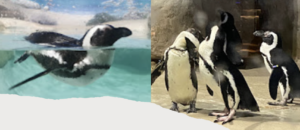
Don’t miss the African penguins. These adorable black-and-white birds are native to South Africa. Because penguins have solid bones, they are excellent divers and swimmers, but they are too heavy to fly. African penguins are listed as an endangered species, and Jenkinson’s Aquarium is part of a Species Survival Plan to help them survive.
While we learned a lot walking through the aquarium on our own, the educators running scheduled feedings provided even more information. We went to both the shark and seal feeding [and you can watch the penguins on a real-time webcam]. Sharks are individually pole-fed three times a week, and most of them are station-trained (trained to go to a specific part of the habitat to feed).
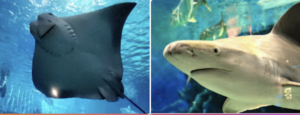
Shark Tank – The largest tank is home to a variety of shark species, including a sand tiger shark, nurse sharks, blacktip reef sharks, and spotted wobbegongs, swimming together with southern rays and cownose rays. Sharks and rays are known as cartilaginous fish due to their skeletal structure being made mostly out of cartilage.
Family-Forward Fun
Jenkinson’s Aquarium offers children a way to easily relate to the marine life, an educational segway to the beach. It is an intimate setting which, with adult supervision, is toddler-friendly, but information-packed, aimed at an Elementary School audience. The youngest visitors will be delighted to get close to all the habitats and wander through the exhibits, while older visitors have an opportunity to learn about animals that are starting to disappear and how to protect them.
We enjoyed the aquarium’s flexibility, allowing visitors to re-enter the aquarium anytime, throughout the day, by showing their handstamp. This is especially helpful with small children. Visitors can wander around the aquarium, leave to enjoy the boardwalk, and then return to go to the feedings or to revisit the exhibits.
Related Posts
-
 An Oasis for Children on the UWS – Play Street Museum
Posted on Jul 9, 2026
-
 Mrs. Christie – Agatha Christie’s Story Reframed
Posted on Jun 1, 2026
-
 Experience the Magic of Schmigadoon! Where Life is a Musical
Posted on Apr 22, 2026
-
 Children’s Museum of Manhattan – a Magical Discovery Zone
Posted on Apr 17, 2026
Tags
Share This


