
The Balusters – Laughing at Boards, Banter and Bias
By Two Sues on the Aisle, Susie Rosenbluth and Sue Weston
Imagine a group of passionate volunteers serving their community, a relatable situation explored in The Balusters, at the Samuel J. Friedman Theatre (presented by Manhattan Theatre Club). This sharp-witted comedy by Pulitzer Prize and Tony Award winner David Lindsay-Abaire, directed by Tony winner Kenny Leon, introduces nine seemingly open-minded board members who see themselves as dedicated civil servants, serving in the best interests of their community. As the group takes on important issues like security, dog-poop, and maintaining the aesthetics of their historic neighborhood, tensions rise, creating explosive, chaotic, hilarious situations.

Photos: Jeremy Daniel
The Balusters, set in the fictional Vernon Point neighborhood, explores human nature, how perception can differ from reality, reflecting unconscious biases, self-interest, and leading to unexpected consequences. The groups’ power struggles and clashing visions feel familiar. Their conflicts hit home, poking fun, and allowing us to laugh at ourselves. We see the blind spots that divide this seemingly harmonious and inclusive community, and recognize them. While the members appear friendly on the surface, chatting pleasantly with each other, their biases begin to show. The Balusters is an entertaining exploration of group dynamics. It is funny and relatable, moving fluidly from one board meeting to the next.

Photos: Jeremy Daniel
A Board of Stereotypical Characters
The show is set in the living room of a tastefully decorated Victorian as the newest board member, Anika (Kyra Marshall), prepares to host her first meeting. She is nervous after her experience on her last board, but determined to make a good impression. As the board members arrive, we are struck by the diversity of the group and the dynamics of their relationship. Ruth (Margaret Colin), who is wearing a rabbit coat, just to annoy Willow (Kayli Carter), a vegan who works at PETA. It’s clear that the Board President, Elliott (Richard Thomas), controls the proceedings, with the meeting’s outcomes aligning with his point of view. Elliot grew up in Vernon Point and considers himself its protector, clinging to its history and traditions. He’s a realtor and has sold most of the houses in the neighborhood. He is charming, so long as he gets his way.
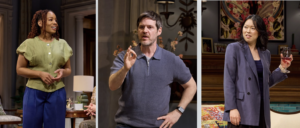
Kyra, Allan, and Milessa
Kyra, an African American woman in her 40’s, was attracted by the neighborhood aesthetics and safety. She is concerned that the traffic at her corner could cause an accident. She was invited to join the board by Melissa (Jeena Yi), an Asian American lawyer, who Penny (Marylouise Burke), the board secretary, confuses with another resident also named Melissa, inquiring politely about her dog and husband (this Melissa has neither).
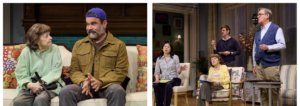
Penny and Issac; Elliot running a Board Meeting
Issac a Latino man who runs a construction company. He did not grow up rich and is proud to live in Vernon Point. Brooks (Carl Clemons-Hopkins) is a gay African American travel writer who is likable, and so is Allan, a private school teacher (Michael Esper), who sees himself as open-minded, but some of his statements come out wrong. He is frustrated trying to be socially correct and failing. Ruth is outspoken, saying things no one else would, stirring up the group, while Willow, the youngest of the group and the most liberal, inherited her house and board position.
The group must deal with two issues: porch pirates and the dangerous corner near Kyra’s house. They politely acknowledge that Kyra’s new housekeeper, Luz (Maria-Christiana Oliveras) a Filipino who used to work for Elliot, but no one can say why she left.
A Lesson in Humanity and Humanity
Elliot sees the board as an enforcer of these standards to maintain the neighborhood identity. He adamantly opposes any decision that could compromise the town he grew up in. His need for control prompts his rejection of the addition of a stop sign and unauthentic balusters, which he feels would ruin the aesthetics of the street. A baluster is a vertical post on a porch railing. Being designated as a historic district, Vernon Point homes are expected to be historically accurate, and not department store quality.

Over time, each character’s blind spots emerge. They all see inclusion in their own image and fail to recognize who was left out. The show picks on all minorities equally, showing how lived experiences influence behaviors. Ruth chooses to hire German help as a way to make up for her family’s persecution. Elliot attempts to recreate the town from his past, failing to notice the absence of minorities (surmising that when he grew up, Italians were considered a minority).
While it is difficult to see one’s own flaws, watching well-intentioned individuals stumble, showing their obvious biases on stage, provided light-hearted entertainment and a lesson in humility and humanity. The acting was sensational, especially the group dynamics.
The Balusters lets us laugh at life, and recognize established patterns and biases that, sadly, we tend to unintentionally adopt.
++++++++++++++++++++++++++++++++++++++++++++++++++++++++++++++++++++++++++++++
Two Sues on the Aisle bases its ratings on how many challahs (1-5) it pays to buy (rather than make) to see the play, show, film, book, or exhibit being reviewed.
The Balusters, at the Samuel J. Friedman Theatre (presented by Manhattan Theatre Club), received 5 Challahs
Running time approximately 110 minutes with no intermission

Five Challah Rating
Related Posts
-
 School Girls; Or, The African Mean Girls Play – Global Language of High School
Posted on Oct 22, 2026
-
 Laughter is the Best Medicine – The Imaginary Invalid
Posted on Aug 26, 2026
-
 Brash, Brilliant, Irreverent – Slam Frank
Posted on Jun 12, 2026
-
 Tarnished American Dream in a Brilliant Death of a Salesman
Posted on May 8, 2026
Tags
Share This


