
Take a Virtual Tour of the Jewish Lower East Side on the Herz Heritage Trail
By The Jewish Voice and Opinion Staff
On May 17 by the Lower East Side Jewish Conservancy (LESJC) launched the Herz Heritage Trail, an immersive digital experience, dedicated to preserving the legacy of Jewish life and the historic structures of Manhattan’s Lower East Side (LES). Named for and benefiting from generous philanthropic support in memory of Roger Herz, the Herz Heritage Trail reconstructs lost and surviving landmarks offering an immersive virtual journey. By combining digital media with interactive storytelling, the Herz Heritage Trail brings the past into the present.
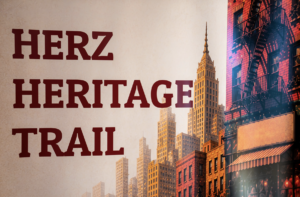
Roger Herz (1933–2022) legendary New York City urban activist and advocate of bicycles. He built a life around public service and devoted his career to supporting NYC. Known for advocating to shift public funds from massive highway projects to public transit. He co-founded the New York Hall of Science in Flushing Meadows-Corona Park, and Transportation Alternatives, the city’s most powerful advocacy group for walking, biking, and public transit. Herz’s estate was used to fund public service scholarships at Hunter College and local cycling events like the NYC Century Bike Tour, as well as the Herz Heritage Trail.
Experience The Herz Heritage Trail
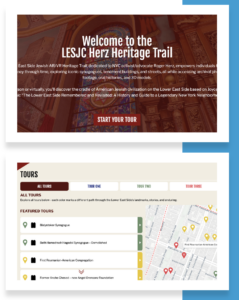
The Herz Heritage Trail is a self-guided immersive digital and augmented reality experience, where visitors virtually walk through the LES using their phones. This initiative, led by Jason Guberman, a digital mapping pioneer, uses modern technology to preserve endangered cultural heritage sites. Guberman, Executive Director of the American Sephardi Federation and Jewish Heritage Preservation leader at the Lower East Side Jewish Conservancy, explained the creation of the Herz Heritage Trail. They combined digital technology to document, preserve, visualize, and analyze cultural, historical sites. The team used archival research, interviews, documentation, and digital reconstruction to produce a virtual and augmented reality experience, with panoramic imagery.
Prompted by concerns over the erasure of Jewish history and the rapidly changing landscape of the LES, The Herz Heritage Trail preserves and shares the LES Jewish experience for generations to come. It can be accessed on-location or remotely, delivering views and information, allowing visitors to wander through the neighborhood while viewing reconstructed images of synagogues, schools, tenements, and Jewish businesses across time.
The Herz Heritage Trail featured sites are organized into four featured self-guided tours, and live (virtually) guided tours, with more tours planned.
- Green: Bialystoker Synagogue, Beth Hamedrash Hagadol Synagogue [with 1 live tour]
- Yellow: First Romanian-American Congregation, former Ashe Chesed [with 2 live tours]
- Red: Congregation Kehila Kedosha Janina [with 1 live tour]
- Blue: Chatham Square Cemetery, the first cemetery of New York’s Spanish and Portuguese Sephardic Jewish community [with 7 live tours]
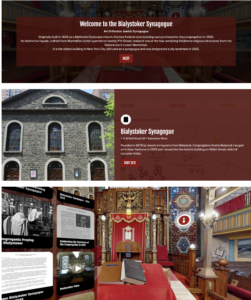
Bialystoker Synagogue
By clicking on embedded content, visitors can virtually explore these spaces which include vintage photographs, articles, recordings, and personal stories. They can also contribute content, or make a donation. The Herz Heritage Trail brings historical preservation alive, using technology to create an engaging, immersive experience.
The Launch Event
The launch was a celebration of the relationship between the LES and New York City, with presentations by Speaker Julie Menin, Allen Lewis Rickman, and Dr David Kaufman. Community recognition awards were given to Larissa and Ami Nahari, owners of The River Wine, and the Honorable Martin Shulman, accepting on behalf of The Bialystoker Synagogue, the oldest building in NYC currently used as a synagogue, and the largest active Orthodox congregation on the LES.

Julie Menim, Jason Guberman, and Dr. David Kaufman
Julie Menin, the first Jewish Speaker of the New York City Council, stressed confronting rising antisemitism across the city with education and security. She announced a $1.25 million grant for the Museum of Jewish Heritage, reinforcing its role in preserving Holocaust memory, to help expand school outreach, and develop a new virtual Holocaust education experience. Sponsored by Speaker Menin, the House of Worship Safety requires the NYPD commissioner to establish plans and protocols to protect entry and exit at religious sites. An Anti-Hate Education bill was passed, requiring the Department of Education to roll out annual, age-appropriate educational materials starting September 2026.
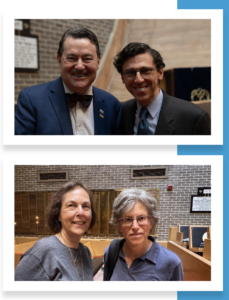
Top – Allen Lewis Rickman & Jason Guberman Bottom – Karen Gibofsky & Sue
Karen Gibofsky, President of the Lower East Side Jewish Conservancy, opened the program with reflections about her own family’s connection to the LES. Noting that “As the city evolves, so does our obligation to safeguard history, elevate heritage, and ensure that the Jewish story of the LES remains visible, vibrant, and valued.”
Author and historian Dr. David Kaufman (known for his 1999 book, Shul with a Pool: The Synagogue-Center in American Jewish History) discussed the LES as the epicenter of the Jewish American experience, home to over two million Yiddish-speaking immigrants from Eastern Europe. At one point, one out of every four New Yorkers was Jewish. During the height of immigration, approximately 350,000 to 400,000 Jews lived within the LES, making it one of the most densely populated places on earth at the time, second only to Bombay and Calcutta. LES became the hub of Yiddish culture, creating a vibrant Jewish American footprint, a link to our heritage.

Related Posts
-
 See How You Can Live Your Best Life – The Black Mirror Experience
Posted on Jun 28, 2026
-
 Friends: A Photo-Centric New York Experience
Posted on Mar 13, 2025
-
 Expedition to The Pyramids of Giza – Virtual Reality Immersive Experience
Posted on Jan 28, 2025
-
 Be Royalty for the Night
Posted on May 3, 2023
Tags
Share This


