
Seeking Justice for Black and Jewish Slave Artists
By Rafael Medoff
Descendants of an enslaved Black artist are fighting to regain works of his that are being held by a number of museums. Among those rooting for their success are the family and friends of a Jewish artist enslaved by the Nazis, who have been fighting for years to regain her paintings from a Polish museum.
Fate, it seems, has again linked the Black and Jewish communities in tragedy, determination, and the fight for justice.
A recent feature story in the New York Times described how the great-great-grandchildren of David Drake have been pleading with major US museums to surrender dozens of artistic jars, some engraved with poetry, that Drake was compelled to create when he was a slave in South Carolina.
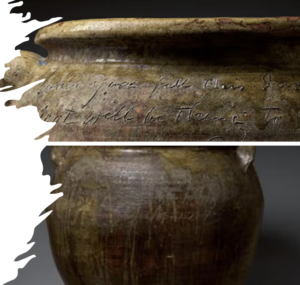
David Drake (ca. 1801–1870s) – Storage jar, 1858. Alkaline-glazed stoneware. The Metropolitan Museum of Art
They are currently on display at New York City’s Metropolitan Museum of Art, the Art Institute of Chicago, and the de Young Museum in San Francisco. Five years ago, a Drake “poem jar” was auctioned for $1.56 million, a new world record for American pottery.
The family’s argument, the Times explained, is that “these objects were essentially stolen from Drake,” because they were “made under duress, and sold or traded without his consent while he was enslaved.”
That sentence struck me when I read it, because as a Holocaust historian, I have been involved with the efforts of the family of the artist Dina Babbitt (born Dina Gottliebová) to retrieve portraits that she, too, made under severe duress—as a Jewish prisoner in Auschwitz. Although the horrors of American slavery and of the Nazi Holocaust obviously differ in significant ways, there are also cruel overlaps that unite the families of Black Americans and Jewish survivors in seeking to reclaim the property of their loved ones.
I called Babbitt’s daughter, Michele Kane, to ask her how she felt about the David Drake story. “It was inspiring to read about the Drake family’s campaign,” she told me. “It feels as if we are kindred spirits in the pursuit of justice.”
Painting in Auschwitz
As a teenager, Dina was deported to Auschwitz along with other Czech Jews. There, the infamous war criminal Dr. Josef Mengele became aware of her artistic talents and ordered her to paint portraits of some of the victims of his savage “medical” experiments. Mengele’s camera had failed to provide evidence he was seeking of their “racial inferiority”; he thought an artist’s renderings might be more useful.
After the war, Dina immigrated to the United States and worked at animation studios in Hollywood, where she drew some of America’s most beloved cartoon characters—including Captain Crunch, Daffy Duck, and Wile E. Coyote.
Many years later, seven of Dina’s Holocaust-era portraits were acquired from an unidentified source by the Auschwitz-Birkenau State Museum, a Polish government institution located at the site of the former Nazi death camp. The museum was able to trace them to Dina because she had signed the portraits “Dina 1944.” (David Drake likewise signed his pots “Dave,” with the date he created them.)
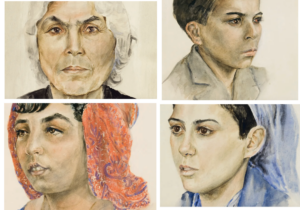
Dina Babbitt had to paint portraits of other inmates in Auschwitz
Dina traveled to Poland in 1973 to verify that they were her works, but, to her dismay, the museum refused to return the paintings to her, claiming they were an inseparable part of its collection.
Remarkably, the Babbitt paintings are not even on display; the museum prefers to exhibit high-quality reproductions of them, keeping the originals hidden away to protect them from damage caused by sunlight or airborne pollutants.
When Dina and her supporters began pressing for the return of the paintings in 2006, the director of the Museum made the astonishing claim that the paintings actually belong to Mengele. They “have never been [Mrs. Babbitt’s] property,” he asserted. “They were made on the order and for the use of … Mengele.”
Professor Thane Rosenbaum, an attorney and Touro University human rights scholar, spearheaded a petition by American lawyers challenging the museum’s claim. He decries the depiction of the arch-Nazi war criminal as some sort of patron of the arts.
“He did not commission the portraits–he ordered her to paint them, and Dina knew Mengele could murder her if she refused,” Professor Rosenbaum told me. “That’s the textbook definition of duress. The paintings belong to the painter, Dina Babbitt, not to Mengele or his heirs.”
A unanimous Congressional resolution upheld her position: “Dina Babbitt is the rightful owner of the artwork, since the paintings were produced by her own talented hands as she endured the unspeakable conditions that existed at the Auschwitz death camp.” Congress instructed the Secretary of State “to make immediate diplomatic efforts” to convince the museum to return the paintings.
They never did. Dina Babbitt passed away in 2009, without ever seeing her paintings again. But her family’s struggle to regain them continues.
The Chain of Ownership
David Rapaport, a California high school teacher, has been a prominent figure in the fight for the Babbitt paintings, teaching his students about the issue and encouraging them to write to government officials.
He argues that the museums in both the Drake and Babbitt disputes are profiting from having the art in their collections and have an ethical obligation to stop doing so. Their refusal to return the art “raises serious questions about whether their commitment is truly to history and justice, or merely to retaining prized artifacts.”
The efforts by the descendants of David Drake, and the family of Dina Babbitt, to regain their artistic works are connected to the legal concept of “chain of ownership.” Under ordinary circumstances, such a chain is established when an artist sells a piece of artwork, and the purchaser subsequently re-sells it or gifts it to heirs. But that doesn’t apply in the Drake and Babbitt cases.
When some of Drake’s pottery was exhibited at the MFA Boston in 2023, a wall label noted that his art was “conceptualized and created under duress,” and therefore the chain of ownership was “broken” because the artist had no control over the fate of his work. The same is true of Dina Babbitt’s paintings. That break does not change the fact that the art belongs to the artist from whom it was taken without permission.
Yaba Baker, one of Drake’s descendants, remarked to the Times: “It’s like two injustices. It’s like you enslaved the man, and then you enslaved the very thing that he made for generations to come. So when does it stop?”
Baker happens to be the producer of an animated series featuring young Black superheroes. Now he’s working on an animated story about David Drake. That knowledge would have been a source of great satisfaction to Dina Babbitt, given her own work on so many iconic American cartoon characters.
Justice for the Drake and Babbitt families will be for the museums to give them back their property. “That won’t change what David Drake and my mother each suffered as slaves,” says Michele Kane. “But it’s the right thing to do.”
 Dr. Rafael Medoff is the founding director of The David S. Wyman Institute for Holocaust Studies and author of more than 20 books about Jewish history and the Holocaust.
Related Posts
-
 Grounds for Sculpture – New Instillation Invites Viewers to Contemplate the Multifaceted Nature of Time
Posted on Sep 23, 2026
-
 When Celebrities Endorsed a Different “Free Palestine”
Posted on Sep 18, 2026
-
Does Jewish Existence Conflict with Human Survival?
Posted on Sep 1, 2026
-
 Why Are They Hosting a Pundit Who Accused Jews of Buying Congress?
Posted on Aug 14, 2026
Tags
Share This


