
Copperfield! – The Musical – Faithfully Follows the Book
By Sue Weston and Susie Rosenbluth, Two Sues on the Aisle
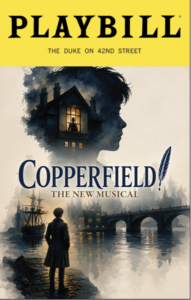
If Copperfield!, book- and songwriter Jeffrey Scharf’s vibrant, ambitious Off-Broadway musical adaptation of Charles Dickens’s famous coming-of-age novel, accomplishes nothing more than encouraging a few lucky audience members to read the original, it will have fulfilled the fervent wish of not only one of the Sues but also countless others who bemoan the current state of waning appreciation for great literature.
The natural tendency to compare Copperfield! to Lionel Bart’s 1960 Oliver! should be avoided, mostly because the two novels are so different. Both were written as serials, Oliver Twist from 1837-1839 to underscore Dickens’s belief that poverty leads to crime, and the highly autobiographical, much more complex David Copperfield from May 1849 to November 1850. Oliver! reflects Dickens’s 160,000-word melodrama, complete with clearly defined villains, coincidences, suspense, and revelations. At more than twice that length, David Copperfield—the book and the musical—is more psychologically nuanced, and so are its characters’ motivations and relationships.
Mr. Scharf chooses not to open his musical like the novel, where David recognizes his many errors in judgment as he progresses from birth to young adulthood, and allows the reader to decide whether or not he is “the hero of my own life.” Instead, Mr. Scharf gives David a simpler quest: finding home.

Photo credit: Jeremy Daniel
Faithful Adaptation
The musical faithfully follows Dickens’s sprawling tale, including many of the characters and subplots, woven together to accentuate the author’s major themes. It opens with the title character (Bobby Conte) as an adult (literary analysts believe Dickens wanted his first-person narrator to be the same age he was when he wrote the book, about 38-40), reflecting on his life. For the first act, he is an observer, watching his younger self (at our performance, Calvin Knegten; other times, it’s Henry Witcher) being born six months after his father’s death.
Abandoned by his great-aunt, the formidable, slightly tizzy Betsey Trotwood (Kara Mikula) when he had the bad fortune to be born a boy instead of the girl she yearned for, David is raised by his loving mother, Clara (Cathryn Wake), and their devoted housekeeper, Peggotty (Amelia Cormack). When Clara remarries, bringing the brutal Mr. Murdstone (Will Reynolds) and his equally despicable sister, Jane (Tatiana Wechsler), into the house, the two tyrants tear the boy from his mother’s arms and banish him to the quintessential Dickensian boarding school. The only benefit he reaps there is the friendship of James Steerforth (Owen Squire Smith)—a happy circumstance for the audience because Mr. Smith is a sensational singer and an athletic, awe-inspiring dancer.
With the death of his mother, David is removed from school and, though still a child, is forced into backbreaking labor—a setting Dickens knew so well. His adventures grow more exciting, spinning into subplots that develop his character and widen his experiences. Is there a soul so cold it doesn’t break for good, honest Ham (Jed Feder) and his beloved, poor Little Em’ly (Nancy O’Connor). The scene in which the Murdstone siblings finally get their just deserts from the still-bumbling-but-loving Great Aunt Betsey and her faithful though slightly off companion and trusted advisor, Mr. Dick (Aaron Michael Ray), doesn’t generate the fist bump it does in the book, but it’s still nonetheless satisfying.
Betsey’s decision to keep David with her paves the road for him, now a young adult, played by the marvelous Mr. Conte, to gain a real education at a school where he develops aspirations to become a writer and lodges with the honorable attorney, Mr. Wickfield (Alexander Sovronsky), and his lovely, kind, intelligent daughter, Agnes (Ms. Wechsler). In what could almost be a modern-day rom-com, everyone expects David and Agnes to marry. She wants to, but they don’t—in no small measure due to the shenanigans of Mr. Wickfield’s clerk, the unctuous Uriah Heep (fittingly played by Mr. Reynolds, who in this role morphs the violent villainy he uses as Murdstone into Heep’s devious malice).
As in the book, David falls head-over-heels in love with the beautiful, sweet, childlike Dora (played by Ms. Wake), who doesn’t come into her own until, on her deathbed, she urges Agnes never to desert David.

Photo credit: Jeremy Daniel
Versatile Performers
The lively company of 13 extraordinarily talented performers brings the Dickens classic vividly to life. Except for the two Davids, each member of the ensemble takes at least two roles and plays at least one instrument. While one of the Sues needed a moment to adjust to the rapid role-switching, both Sues agreed the performances were superb and the fluidity added to the experience. Coupled with the engaging music, the cast’s charm, expertise, and versatility made the show memorable.
The intimate staging by director-choreographer Gabriel Barre fits the small theater, The Duke on West 42nd Street. Sometimes the action extends into the audience, such as when David and amicable, optimistic, perpetually-in-debt Mr. Micawber (Andy Taylor), commandeer two seats in the first row and read Playbills to avoid detection.
Edward Pierce’s scenic design calls for raised balances that work beautifully to create the illusion of being aboard a boat, in an office, or on a balcony while simultaneously serving as a musical platform.
Until the 1960s, David Copperfield was required reading certainly by high school, which may account for the preponderance of older adults in the audience at the performance the Two Sues attended. Smiles and nods abounded with every twist and turn onstage. The Sue who was less familiar with the story found the merging parts and plots a bit confusing, but appreciated the production’s steady stream of action—fast-paced actors and musicians popping up on stage, instruments in hand – which kept the plot future-focused.
That’s not to say she wouldn’t suggest a bit of tightening and maybe removing some of the less relevant characters and songs for a crisper show. All in all, both Sues agree that Copperfield! offers a fun, high-energy production that marries song and dance to enhance the storyline. It has earned its exclamation point.
Related Posts
-
 “The Heart” has Soul
Posted on Nov 3, 2026
-
 A Powerful Story – MIDNIGHT
Posted on Oct 16, 2026
-
 Would That Going Bacharach Went Somewhere
Posted on Sep 2, 2026
-
 Brash, Brilliant, Irreverent – Slam Frank
Posted on Jun 12, 2026
Tags
Share This


