
Family-Inspired Holocaust Remembrance – Ryan Lilienthal
By The Jewish Voice and Opinion Staff
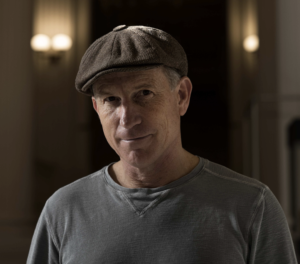
Searching for his family’s history took an unexpected turn for Princeton artist Ryan Lilienthal.
Family History
Family has always been important to Lilienthal. All four of his grandparents fled Nazi Germany, but many of his family did not get out. His mother’s parents fled Berlin after her father, a doctor, was barred from practicing medicine, and her mother was prevented from continuing her studies in mathematics. His father’s mother remembers seeing Hitler march into Vienna. A cousin remembers standing with her mother as she was forced to clean the road.
Lilienthal’s maternal grandparents rarely spoke about the past, but a folder of letters tucked away in his grandfather’s recently surfaced stamp collection contained clues–sometimes hinting, sometimes screaming–of the family’s traumatic Holocaust past. One envelope postmarked November 1941 from Lilienthal’s great-great-uncle and aunt, Theodor and Mina Israel, and their son, Walter, exposed the family members’ uncertainty about a way forward. They would have been unaware that the Nazis had already decided their doomed fate.
Fifteen years of research produced results, revealing that the Israel family’s history had been meticulously preserved because they were the last Jews in their village. The mayor kept every record, including a document from a local clay factory, requesting that Theodor continue working in the factory to make bricks. Although the Israel family applied for U.S. visas, only Walter qualified. They never immigrated. Records indicate that Theodor and Mina were lost without a trace, and Walter, separated by the Nazis from his parents on the deportation train, appears on a crematory ledger for the Majdanek concentration camp. He was sixteen years old.
For Lilienthal, COVID prompted a career change, from practicing law to studying art and design. His visual inclination was part of his family history. His mother was a painter and jewelry maker, and his grandfather was an amateur photographer in Berlin in the 1920s.
Creating an Interactive Memorial
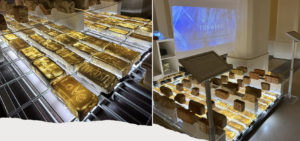
Lilienthal transformed his family history into a multi-media art installation, combining digital media and bricks as part of his Rutgers Master’s Thesis. This work may change the way we create remembrance, allowing visitors to interact with memorials. He created a digital wall of scanned documents that visitors can move, creating an interactive experience. As you move through time, the documents get heavier. Layered in are digital event pillars of rubble. One is broken glass symbolizing Kristallnacht, with video projections in constant motion. The second pillar is sound with music, drumming, and vocals (composed by Lilienthal’s son, Noah).
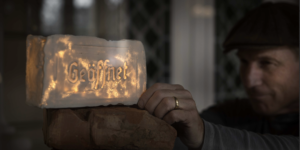
Last came the bricks. Lilienthal considered doing something in Germany, using clay from the same pits worked by Theodor to make bricks, but now it is a nature preserve. His search for a kiln led to a design school in Frankfurt with a program for working with porcelain. He envisioned using this to create bricks to create an illuminated memory when light passed through them.
Copyright: HLA. Hessisches Staatsarchiv Darmstadt
Lilienthal applied for a Fulbright in 2024 to fund a German-based participatory memory sculpture in collaboration with Goethe University, the Hessian State Archive, and Darmstadt-area high schools. The proposal gained the initial recommendation from the U.S. Fulbright committee but was ultimately funded solely by the German-American Fulbright Commission through the German government.
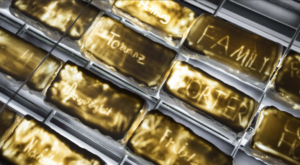
The project progressed, working with 6 schools in Germany, including the elementary school that Walter and his mother attended. Through this collaboration, the German students produced 150 hollow bricks inscribed with words associated with a sense of belonging.
Ryan Lilienthal – Copyright: HLA. Hessisches Staatsarchiv Darmstadt
Making An Impact
Lilienthal’s work is making a big impact. For many of the people he partnered with in Germany, he was the first Jewish person they ever met. The Fulbright project allowed him to interact with 150 students across six schools to create a large-scale collaborative installation, cultivating with them a growing appreciation for mutual empathy and common humanity. While creating art, this experience was a healing process, bringing Lilienthal’s family story a sense of closure, building a shared experience with these German students, and imparting an intimate understanding of the Holocaust. Together, they created translucent porcelain bricks inscribed with words related to identity, belonging, and memory.
Copyright: HLA. Hessisches Staatsarchiv Darmstadt
Related Posts
-
 Slam Frank – A Chutzpadik Satire of Society
Posted on Nov 9, 2026
-
 San Diego’s Chinese Museum tells Stories of Shanghai Refugees
Posted on Aug 26, 2026
-
 Discovering a Hidden Past – For the Love of a Woman
Posted on Jul 2, 2026
-
 Almost 90 Years Later the Issues Still Resonate – My Lord, What a Night
Posted on May 15, 2026
Tags
Share This


