
Hershey Felder: The Piano and Me–A Dazzling Display of Theater and Music, Especially for Those Who Love the Latter
By Sue Weston and Susan Rosenbluth – Two Sues On The Aisle
Several times in Hershey Felder: The Piano and Me, the superb pianist and actor, playing his own Polish-Jewish widowed immigrant father, Jacob, looks out at the audience and wonders about his child prodigy of a son: “From this will he make a living?”
It’s the question asked by almost all parents who realize a child of theirs is showing a spark of artistic genius, a wunderkind who combines sheer talent with the kind of passion that pushes him to forsake normal school-age pastimes to practice to perfection the works of the great masters. In the Felders’ 1970s-’80s Yiddish-speaking Montreal household, the joy of realizing how well six-year-old Hershey can play works for the piano by his Hungarian grandfather’s favorite composer, Franz Liszt, coincides with the simultaneous fear: How will the boy ever make a living?
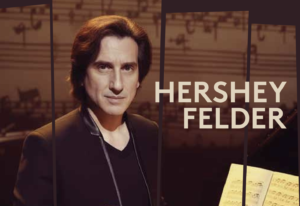
Fortunately for the Felders—as well as music and theater lovers everywhere—young Hershey managed to find a way. His credentials were all there: the best piano teachers the child’s immigrant family could find (no matter what had to be sacrificed to afford them or transport him to their locations), matriculation at McGill University’s Schulich School of Music, traveling weekly from Montreal to Manhattan by himself by car for years as an adolescent just to study with the head of the Juilliard piano department. Nevertheless, the fear the elder Felder voiced was not without reason. Young Hershey may have successfully—and even brilliantly—satisfied his teachers’ epic requirements, but, at the very same time, so did hundreds of other piano virtuosos at conservatories throughout the United States, Canada, the Western World, Israel, and Asia.
It helped that, along the way, Hershey developed another passion—for theater and storytelling, a gift he was able to hone in the Yiddish-speaking world of his childhood and adolescence. By combining breathtaking skill at the piano with an easy, engaging ability to breathe life into multi-person scenes—all of them written by himself—Hershey Felder has achieved what so many of his fellow child prodigies found impossible: He has successfully made a living as a pianist and actor, performing in countless theatrical productions, written by himself, that have transformed classical composers into living, breathing human beings whose works are vital to the canon of Western Civilization.
Creative Non-Fiction Depictions
Like all his theatrical works, his first play was based on a true-life incident. Entitled Sing! A Musical Journey, it is based on an anecdote told to Hershey Felder in 1995 by Helmuth Spryzcer at the 50th anniversary commemoration of the liberation of Auschwitz in Poland. Felder, who had used his Yiddish and French to interview survivors for Steven Spielberg’s Shoah Foundation, had been sent to Auschwitz to lift the spirits of the former inmates who chose to attend the ceremony. In a deeply moving segment of The Piano and Me, Felder recalls Mr. Spryzcer’s story of how the German guards made him whistle George Gershwin’s Rhapsody in Blue. “Gershwin was a prophet,” says Mr. Felder as Spryczer, insisting that melody foretold the suffering of his people.
In 1999, Mr. Felder performed his one-man show, George Gershwin Alone, focusing on the life and music of the American-Jewish composer. It played throughout the world, paving the way for Monsieur Chopin, Beethoven as I Knew Him, Maestro (about Leonard Bernstein), Our Great Tchaikovsky, and Hershey Felder as Irving Berlin.
For The Piano and Me, Mr. Felder uses the same dynamics employed in his former works to tell his own story, but there is no question that, this time, the subject terrifies him, for it shows how a gifted child lost his mother to breast cancer at a very young age and then dealt with his grieving widowed father and his Holocaust survivor grandparents on both sides. Through friends in high places, his father’s Polish parents managed to escape to Canada while the war was still raging, but they had to leave a daughter behind, and she “disappeared.” His mother’s Hungarian parents also survived—but had no idea how to deal with their daughter’s “disappearance” to illness in the place where they were supposed to be safe. Hershey Felder himself had to deal with Canadian antisemitism.
Dramatic Virtuosity, Maybe at a Price
While very little of The Piano and Me focuses on Jewish religious life, Jewish history and struggles are interwoven into the story, showing once again how particularist details impinge on the universal.
Freed from having to stick to one composer’s work or even those who influenced him, Mr. Felder presents a panoply of pieces, each learned at a different stage of his development and all designed to show his virtuosity, love and attention for details, and dramatic understanding of what works on stage. One of the Sues found this mesmerizingly good. The other thought the story outweighed the music, which, she felt, went on too long.
Both Sues agree Hershey Felder: The Piano and Me is, by turns, funny, awe-inspiring, and poignantly tragic. It allows the playwright to explore dazzling works that shaped him, expounding on them with personal stories that, whether amusing or tragic, always resound with the unmistakable aura of truth.
One of the Sues hopes Mr. Felder will bring this show back to New York once its brief run at 59E59 Theatres ends. Even better, she said, it should be filmed. What a wonderful gift to show any budding young pianist—and his or her parents—that the impossible can be obtained.
Mr. Felder does indeed make a living in the arts, and one Sue—the one who would give Hershey Felder: The Piano and Me 5 challahs—thinks the world is the beneficiary.
Related Posts
-
 “Eureka Day”: What If the People with Whom You Passionately Disagree Are Not Villains?
Posted on Feb 27, 2026
-
 50 Years after Vietnam – Rolling Thunder Rock-documentary
Posted on Aug 22, 2025
-
 Last Call: Bernstein and von Karajan Didn’t Have To Be Portrayed by Women, Just More of the Conductors Themselves Would Have Been Enough
Posted on May 11, 2025
-
 Play Presented at ZOA Probes Free Speech and the Middle East Conflict
Posted on Apr 16, 2025
Tags
Share This


