
The Last Woman of Warsaw – A Tribute to the Past
By Sue Weston and Susie Rosenbluth, Two Sues on the Aisle
The Last Woman of Warsaw is a historical fiction novel written by Judy Batalion, set in 1938 Warsaw, a period of rising antisemitism. We follow two Jewish women struggling to save a friend and find themselves. They are an unlikely pair. Fanny Zelshinsky is sophisticated, from a wealthy family, attending university, and preparing for marriage, but wanting more. Zosia Dror, whose shtetl was destroyed by a pogrom, is street smart and dreams of a visa to immigrate to British Palestine. The girls are driven to act. They hope to improve their opportunities by locating Wanda Petrovsky, an iconic photographer and activist, as the world changes.
In The Last Woman of Warsaw, Batalion memorializes “Warsaw’s golden age of creativity and the Jewish art and culture that, along with six million lives, was also decimated in the Holocaust.” This story is deeply personal. All of Batalion’s grandparents were survivors who escaped from Nazi-occupied Warsaw during World War II.
Batalion creates an exciting race against time, uniting two protagonists in a daring adventure. And both women are attracted to the same boy, Abram, which adds some spice and competition to their relationship.
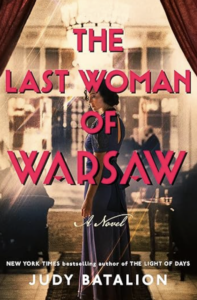
An Unlikely Pair
It is a story of youthful hope and exuberance as Fanny and Zosia solve the mysterious disappearance of Wanda Petrovsky, learning more than they anticipated. Batalion’s narrative shifts between the girls’ perspectives.
Fanny grew up privileged and exudes confidence, which she pairs with chocolate to get what she wants as they search for Wanda. She uses her camera to record the escalating hostilities. Fanny is fighting to maintain her ability to be taken seriously as a photographer.
She considers Wanda her mentor and the key to her future. If Wanda approves her transfer of majors, she can participate in an upcoming art exhibition. Her mother has other plans, hoping Fanny will marry her childhood friend, who she is engaged to, which would allow her to maintain the lifestyle she has grown accustomed to. Fanny is expected to marry and then move to the country to raise a family, sacrificing her freedom to pursue photography. Besides, they are not in love.
Zosia is an active part of the Labor Zionist youth movement and needs Wanda’s support to secure a visa to immigrate. She is scrappy, unaccustomed to luxury, and amazed by Fanny’s carefree air of entitlement. Zosia leads them through the underground and seedier sides of Warsaw.
She is still suffering from the trauma she experienced in the shtetl. She was forced to watch as her house was burned down, which left her father seriously injured. Zosia was truly disappointed by her neighbor’s refusal to help. She funneled her energy into finding a way to leave Europe and joined the Zionist movement, recognizing the importance of political activism and education. She believed that if she could move into a leadership role, she would have a better chance of getting a visa to emigrate to British Palestine. This path landed her in Warsaw, where she received letters from her mother imploring her to return to the shtetl, to help with the store, and to be at her sister’s wedding.
Part of a Larger Narrative
Fanny and Zosia are racing against time, watching as the antisemitic fervor in Warsaw steadily increases. Polish right-wing groups began terrorizing Jews. In one scene, the police raid a club where Jewish comedians are performing. The girls and Abram were in the club and escaped just in time. At Warsaw University, Jewish students, who were already subject to admissions quotas, are singled out, forced to sit on the “Jew bench,” and Jewish teachers are routinely dismissed. As part of the youth movement-led protests, Zosia actively urges students to boycott class, and Fanny captures the event on film. There are parallels with present-day attitudes on college campuses, and as Warsaw, the city with the largest Jewish community in Europe, turns on its Jewish neighbors.
The epilogue offers a unique perspective, as Fanny’s granddaughter uses fragmented memories, artifacts, and assumptions to reconstruct the past. The Last Woman of Warsaw is a fitting tribute to the past, weaving a captivating story of courageous decisions and the complex culture of 1930s Polish-Jewish feminists.
Related Posts
-
 Alina Bonsell Criticizes Mamdani’s Antisemitism Plan: “Where is the Accountability?”
Posted on Sep 30, 2026
-
 UJA-Federation of New York Issues Message to Mayor Mamdani
Posted on Jul 22, 2026
-
 Secrets, Spies and Lies – Who Can You Trust? – The Star Society
Posted on Jul 14, 2026
-
 Discovering a Hidden Past – For the Love of a Woman
Posted on Jul 2, 2026
Tags
Share This


