
“What Became of Us” Immigrant Siblings, and their Strong Connection
By Two Sues on the Aisle, Susie Rosenbluth and Sue Weston
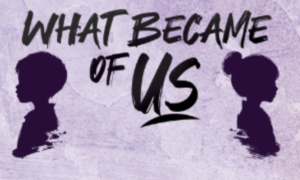
At its core, What Became of Us, playing at the George Street Theater in New Brunswick through April 5th, explores not only the complicated-but-eternal relationship between siblings but also the universal immigrant experience confronted by anyone who ever arrived in a new country—or lived with someone who did.
For 80 minutes, without intermission, playwright Shayan Lofti allows his characters—an older sister, played by Christine Toy Johnson with exactly the right mixture of awe, vexation, and concern fitting an oftentimes surrogate parent, and her younger brother, played exquisitely by Francis Jue as a carefree, more rambunctious individual who knows who and where he is—to tell the story as well as act it out.
By design, the particulars are vague. The sister is identified only as Q, her brother only as Z. She emigrated as a young child with her parents from a place known only as “The Old Country;” he was born a few years later in “This Country”—the family’s never-named new home. Sufficient clues are dropped to make it clear Mr. Lofti means the United States, but exactly where is never pinpointed. One of the Two Sues thought the family settled on the East Coast, and, when the brother moved, it was out west. The other Sue had just as valid reasons for thinking it was the opposite.
The siblings refer to their unseen, never-named parents as “he” and “she.” Q and Z provide insights into their shared childhood, usually by referring to one another as “you.” Mr. Lofti is determined to give no clues, and, thus, the play’s universality shines through.

Francis Jue and Christine Toy Johnson
Leaving
The production begins with Q’s folk-tale-like explanation for her parents’ decision to leave “The Old Country,” where, despite their good educations and decent jobs, they, like so many of their friends and family before them, yearn to relocate to a place where they and their children can be free to build better lives. After selling most of their belongings and moving to “This Country,” they struggle to become small shop owners, requiring the help of their daughter to keep the business afloat.
“They embarked on a journey harder than some, easier than others. They traversed unfamiliar terrains, witnessed breathtaking landscapes, made friends, navigated antagonists, received kindnesses, and were subjected to cruelties,” Q recalls.
The detail she remembers best about her brother’s birth is her parents showing up at her school when her mother went into labor. They needed their daughter at the hospital to speak for them in This Country’s language.
A universally relatable story, told from the children’s perspective, it presents baffled immigrant parents working hard to provide stability in their new, confusing life—even if that means pushing their older offspring into a quasi-adult role and often ignoring their younger ones.

Sacrifices
As the obedient, academically successful daughter, Q seems to barely realize the sacrifices she makes for her parents, such as relinquishing a prestigious scholarship so she can help in the store. Z, on the other hand, has no problem placing his desires before those of his family and chastising his sister when she doesn’t see it that way. When he decides to attend culinary school across the country, is it an act of selfishness and immaturity? Was her decision to remain close to her parents and become a librarian a show of loyalty, recognition of the obligation to care for those who had sacrificed so much to bring them to “This Country,” or was it just fear of not living up to their expectations?
At one point, Q says sarcastically to Z, “I’m thinking I should have been more like you: self-absorbed, self-indulgent, self-serving.”
“How sad, that’s how you view someone just living their life,” Z responds.
As is true of so many first- and second-generation Americans, Q and Z both achieve a healthy modicum of success, but not without cost. The price of “just living your life” can mean the inability to retain the most basic of relationships—at least not without a lot of hard work.
Throughout the play, the interactions between Q and Z retain the iconic expressions of sibling love despite rivalry, jealousy, and regret. Beautifully portrayed by Ms. Johnson and Mr. Jue, Q and Z are eminently believable. When they end and then re-establish their relationship, the “Hallmark” family dynamic produces that bittersweet recognition of just how deep—and indestructible—the chains binding siblings to one another really are, even after decades of silence.
A Great Performance
Rather than focusing on any single culture’s history, What Became of Us demands recognition of the issues surrounding immigrants, family, and siblings. The powerful ending challenges the audience to acknowledge the difficulties faced by the elderly and that, so often, they did the best they could.
The time spent with these ordinary people living unremarkable lives demonstrates how hard it can be to protect the ones you love, how resolutely the effect of strong families resonates from one generation to the next, and how much we all need connections.
Watching Ms. Johnson and Mr. Jue waltz around each other as ordinary people establishing their own rhythms as they reconnect with their joint past, showing and receiving compassion, makes this play riveting.
+++++++++++++++++++++++++++++++++++++++++++++++++++++++++++++++++++++++++++++++++++++++++++
Two Sues on the Aisle bases its ratings on how many challahs (1-5) it pays to buy (rather than make) to see the play, show, film, book, or exhibit being reviewed.
What Became of Us, playing at the George Street Theater in New Brunswick through April 5th, received 4 Challahs

Four Challah Rating
Related Posts
-
 Rosenbluth Publishes First Novel: Blurred Vision
Posted on Jul 7, 2026
-
 They Could Have Been Saved
Posted on May 13, 2026
-
 Walking Charlie by Gary Morgenstein: A Very Modern Love Story
Posted on Dec 18, 2024
-
 Families Can Be Complicated – The Saviour
Posted on Aug 18, 2023
Tags
Share This


