
Marcel On the Train Recalls the Making of an Artist and a Hero
Reviewed by Susan Rosenbluth [Susan Rosenbluth’s novel, Blurred Vision, will be out this summer from Red Adept Publishing]
Anyone who has ever been unexpectedly thrust into a position of responsibility—or can imagine how it would feel—can empathize with the very young Marcel Marceau, who found himself in exactly that situation during the Nazi occupation of France. Why and how the young man, who only a few years later blossomed into arguably the finest and certainly most renowned mime of all time, dealt with the challenge of leadership and obligation is the subject of the riveting Marcel on the Train. Co-written by Ethan Slater, who also plays the title role, and Marshall Pailet, who served as director, the play is showing through March 22 at the Classic Stage Company in Manhattan.
Born Marcel Mangel, Marceau was barely 20 when he undertook the first of three missions for the Oeuvre de Secours aux Enfants, a secret Jewish unit of the French Resistance, escorting French-Jewish children by train to freedom in Switzerland. According to some reports, by the end of the war, he had rescued about 100 Jewish children. Marcel on the Train concerns itself with a fictionalized version of the first of those assignments, a terrifying episode in which he—played by Mr. Slater with a perfect combination of kidlike authority and comradely affability—was asked to accompany four Jewish 12-year-olds from an orphanage in Sèvres on a train bound for the Swiss Alps.
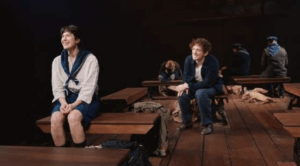
Tedra Millan and Ethan Slater with Maddie Corman, Max Gordon Moore, and Alex Wyse. Photo by Emilio Madrid
He was supposed to be relieved en route by his cousin, Georges (Aaron Serotsky in one of his several single-scene parts), who, for reasons unclear until the end of the play, doesn’t show up. Marcel is thus left in charge of the two girls and two boys, all with forged papers and dressed like French Boy Scouts. Played by adults, these actors initially require a little willing suspension of disbelief to win acceptance as kids, but from the minute Berthe (Tedra Millan) demands a bathroom and eventually, with a smirk, accepts a substitution; Henri (Alex Wyse) boasts that he can outsmart the Nazis; Etiennette (Maddie Corman) refuses to speak—almost certainly as a reaction to trauma she has already experienced; and Adolphe (Max Gordon Moore) flashes his all-too-thorough understanding of what they face, they become children on the cusp of adolescence—knowing, smart, and oh-so vulnerable.
Marcel also had changed his name, adopting Marceau not only to sound less Jewish but also to honor François Séverin Marceau-Desgraviers, a general of the French Revolution. He understands his and the children’s survival depends on him. Not only must he see them safely to Switzerland—by himself—but also with as little permanent emotional damage as possible. How he endeavors to accomplish this takes up the bulk of the play’s 100 minutes, performed without intermission. No wonder it is not recommended for children under 13.
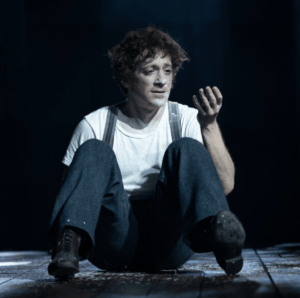
Ethan Slater as Marcel Marceau
After the war, a fellow member of the French Jewish resistance said of Marceau, “[He]started miming to keep children quiet as they were escaping. It had nothing to do with show business. He was miming for his life.”
In Marcel on the Train, he uses every tool at his disposal—jokes, mimed action, shadow plays, stories, and deceptions—to keep the children focused, behaved, and prepared to convince the ever-prowling Nazis they are all French boys interested only in spending a few days with nature in the Swiss Alps.
While still on the train, recreated in all its claustrophobic glory by Scott Davis, Marcel realizes that who the children will become depends on what he tells them—and himself—about their experience: “When we remember this time, and we will, all of us will remember this time, we’ll have no end of … wonderfully rotten memories to choose from. Of cruelty. Of indifference. Of one masked as the other. Wouldn’t it be better if we chose a ridiculous memory instead?”
That philosophy meets its challenge when a Nazi official, again played by Mr. Serotsky, barges into their car. Marcel and the children assume he is a German officer, but he seems all too willing to assume he is speaking to four French Boy Scouts and their leader. Or does he? Although the official assures the terrified impostors this is a routine inspection, he admits he is a French citizen “performing his duty” to catch some runaway Jewish children who have escaped from the orphanage. Does he know who the passengers he faces are when he allows them to go on their way unmolested? Uber-realistic Adolphe is sure that it is the case, but a glance from Marel toward the audience suggests recognition that the German persecution depended on local collaborators.

Using flashbacks and afterwords, the play lets us know that almost all its characters—real and imaginary—survive the war. The exception is Marcel’s father, a kosher butcher, played once more by Mr. Serotsky, who refused to flee France and, as a result, was taken by the Nazis and murdered at Auschwitz. For those who traveled with Marceau on that train, the trauma of that fateful trip remains a palpable presence. For some, Marcel’s ability to transmit the insanity of the situation provides relief during times of danger. Others derive pleasure just knowing the by-now world-renowned artist has not forgotten them.
As Marcel, Mr. Slater is nothing short of wonderful. His physicality as a comic, coupled with unpretentious impish playfulness even in the face of overwhelming horror, takes the actor, acclaimed as Boq in both Wicked films, to new heights. At the conclusion of Marcel on the Train, he duplicates Marceau’s award-winning pantomime, “Bip and the Butterfly,” featuring the mime’s innocently funny-and-always-hopeful iconic persona, inspired by Charlie Chaplin’s Little Tramp. Mr. Slater’s beautiful fluidity of motion makes it easy to remember Chaplin’s ballet with a world globe as his partner in The Great Dictator. Released in 1940—before either Pearl Harbor or America’s entrance into World War II—the film mocked Hitler. On the train with the children, so did Marcel. There is no greater form of resistance.
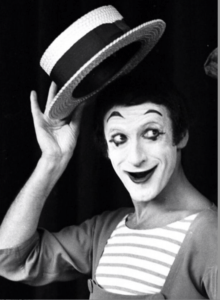
The real Marcel Marceau
Related Posts
-
 Heathers the Musical – Future Cult-Classic Takes the Theater by Storm
Posted on Sep 11, 2026
-
 High Quality Local Theater – Driving Miss Daisy
Posted on Aug 16, 2026
-
 The 25th Annual Putnam County Spelling Bee – BRILLIANT and FUNNY
Posted on Aug 3, 2026
-
 The Catskills 1969 A Time of Change – Broadway Bound
Posted on May 21, 2026
Tags
Share This


