
Three One-Man Plays, Three Questions: Does Shylock Trigger Antisemitism or Expose It? Is Hannah Senesh More Myth Than History? Why Not Include Mark Twain’s Views on the Jews?
By Susie Rosenbluth
Three one-man plays were on display in and around New York in early November—two with definitively Jewish themes. The third one could have had one —but didn’t.
The questions that must be asked: Is it antisemitism when something positive about Jews is omitted? Is it antisemitism to cancel a story that has traditionally been said to show Jews in a negative light when all it takes to humanize the characters is to fully understand them?

The only one of the plays still running is the provocative and powerful Playing Shylock, which can be seen at the lovely Polonsky Shakespeare Center in Brooklyn until December 7.
The production, starring the passionate and redoubtable Saul Rubinek, is a must for anyone who cares about what antisemitism means, why Jews are too often our own worst enemies, and how the exploration into the often-ephemeral tie between parents and children should be viewed. In a tour-de-force worthy of the most compelling Shakespeareans, Mr. Rubinek plays a character named for himself, using a script he assures us he did not write—but the audience may be tempted to take that denial with a grain of salt.
The playwright, Mark Leiren-Young, based the work on his own 1996 play, “Shylock,” that Mr. Rubinek says he hated. When Mr. Leiren-Young offered to rewrite the piece, Mr. Rubinek said That’s not what it needed. “It needed a ‘write.’”
As a result, Mr. Leiren-Young, a distinguished playwright, author, journalist, screenwriter, filmmaker, and performer, ploughed through decades worth of videos, paperwork, and interviews with Mr. Rubinek; his family; and his friend and director, Martin Kinch, in order to come up with the current play. Its conceit reflects Mr. Leiran-Young’s predilection for so-called mocumentaries—an actor named Saul Rubinek has won the role of Shylock in a New York production of The Merchant of Venice, only to receive the news, just after the first intermission, that the run has been canceled. It seems some people, purporting to represent the “Jewish community,” have convinced the theater that this production “at this time” is not “in the best interests” of Jews. They fear it will provoke antisemitism.
A stupefied Saul Rubinek, dressed like a hareidi Shylock right out of Boro Park or Mea Shearim, faces the audience, half-furious, half-amazed. “Right now, when you can’t go into a synagogue without passing armed guards, the real danger to our wellbeing is The Merchant of Venice? Oh, okay.”
For the next hour and a half, Mr. Rubinek engages in a conversation with the audience. It feels like an impromptu, albeit one-way dialogue, but in a post-performance interview, he insisted it’s all scripted. His subjects range from a scholarly explanation of what The Merchant is really about (“Shylock was the first three-dimensional character in the history of English literature” and the first major role in the theatrical canon specifically written for a Jew) to an all-too-true polemic against those who would shut down a play in the name of the “Jewish community” (“When did the culture wars turn into a circular firing squad?”).
Many of the most deeply serious issues the play tackles are interlaced with humor. For example, the set, designed by Shawn Kerwin, is supposed to be for The Merchant’s courtroom scene in which Shylock sues for his pound of flesh when the antisemitic Antonio cannot repay his debt. A huge cross looms over the players, prompting Mr. Rubinek to refer to the cancellation of the play with a joke: “I should have known. The last time a Jew got this close to a cross, it didn’t end well.”
Poignancy punctuates the evening, especially when Mr. Rubinek recounts his own career in the theater and how it resonated for his parents. It doesn’t take a Freudian to see how much of what he — as the actor or the actor playing the actor—does is, in part, a tribute to his own father, a Holocaust survivor and pre-war Yiddish actor, whose career, Mr. Rubinek says in the show, “was also canceled by Hitler.” The discussion the older Mr. Rubinek conducts with his own father, a Torah scholar who doesn’t see the theatre as a suitable career, is heart-wrenching.
The part Mr. Rubinek’s father yearned to play was, of course, Shylock, which explains why the actor finds the on-stage cancellation doubly painful. In truth, it was probably a dashed dream for countless Jewish actors. Playing Shylockpoints out that, for centuries, the part has been played primarily by gentiles. Many of them, including Laurence Olivier, Al Pacino, and Patrick Stewart, have garnered accolades for their portrayals—most of them sympathetic. Mr. Rubinek suggests Jewish actors have been denied the part for fear the character’s essential Jewishness will shine through.
Mr. Rubinek gives just a hint of what his Shylock would look like — a masterful portrayal based on a thorough understanding of who the character is and the environment in which he lived. Furious at the treatment he has been accorded at the hands of Antonio and his familiars, Shylock doesn’t demand monetary interest for the loan he’s asked to give, but, rather, the ludicrous “pound of flesh.” By the time Antonio defaults and Shylock takes him to court, the Jew’s daughter has also betrayed him, running off with a penniless Christian, stealing her father’s money, and converting to Christianity, thus ending the family’s line in the Jewish community. Mr. Rubinek has no problem showing the audience a Shylock who has reached his breaking point.
To demonstrate his thorough understanding of Shylock’s emotional state, Mr. Rubinek adds some dialogue to the court scene. In addition to Portia’s famous speech extolling “the quality of mercy,” recited to exhort Shylock to relinquish his demand for Antonio’s flesh, Mr. Rubinek has her quote from the Talmud, explaining that Jewish law would also forbid him to collect this price. But by this time, Shylock is beyond reason.
Audiences from the original Elizabethan ones to those centuries later have been encouraged to see Shylock’s intransigence as representative of the quintessential “Jew.” In Mr. Rubinek’s hands, however, the moneylender’s emotional response is quintessentially human.
And that is the point of Playing Shylock. Does The Merchant of Venice inspire antisemitism, or, if performed in the right hands, does it expose the roots of Jew-hatred and what it can lead to when it erupts?
By the way, it’s probably safe to say no one who sees Playing Shylock will ever think of Shakespeare, the playwright and poet, the same way. Mr. Rubinek’s argument for assigning the Bard’s work to Edward de Vere, 17th Earl of Oxford, is so convincing, only a stiff-necked dogmatist could resist doing more research. (For those interested, the late Professor Tom Regnier of the University of Miami School of Law wrote a piece entitled “Top 18 Reasons Why Edward de Vere Was Shakespeare.” How about this tempting hint: de Vere lived in Venice for a while and knew the real Jew on whom Shylock was based.

Although the run is now over, the National Yiddish Theatre Folksbiene presented Hannah Senesh, the moving story of the young Jewish-Zionist diarist-poet who escaped from Axis-allied Hungary in 1939 to the safety of British Mandate Palestine. Five years later, she returned to Europe, intending to rescue Jews—especially her mother.
The play establishes that saving Jews was never the goal of the British High Command that organized the March 1944 operation in which the 23-year-old Miss Senesh took part. Playwright and director, David Schechter, makes it quite clear that the real point of parachuting 37 Jewish-Palestinian soldiers behind enemy lines into Yugoslavia was to rescue downed Allied pilots. As an afterthought—a sort of reward if there was time—the Palmach volunteers would be allowed to cross into Hungary to warn local Jews about the gas chambers Hitler had in store for them.
It was always considered a suicide mission, and there is some evidence that Miss Senesh knew it even when she was fighting alongside the local partisans. In June 1944, a few days after the Nazis occupied Hungary, she, desperate to at least see her mother, proceeded—against everyone’s advice—to cross the border.

Within hours, she was captured and refused to seek refuge as a British soldier. Instead, she identified herself as a Jew (her patch as a “Palestinian” was sufficient—in 1944, no one thought that applied to Arabs) and underwent months of torture, refusing to betray any British and Jewish troops. Accused of being a Hungarian traitor, she was given a show trial and executed on November 7, 1944.
In her diary, she had written that even if she should die, “the Jews will know someone came to try to rescue them.”
The British High Command, it seems, knew just what they were doing when they sought Palestinian Jews to undertake the mission of rescuing pilots. Jews were considered “brilliant”—educated, able to speak the various European languages, and well-versed with the terrain. Miss Senesh, the daughter of a well-known playwright who had died young, used to vacation in the Yugoslavian area where the Palmach troops landed.
Choosing the Palmach volunteers paid off well for the British High Command. These Jews did save some Allied airmen, and in the firefights they conducted, they probably killed their share of Nazis.
In the play, although Hannah saved no Jews, her mother points out that she did bring hope to some of her fellow prisoners, letting them know at least some people in the outside world were aware of their plight. During a poignant talkback after one production, it was mentioned that while in prison, Miss Senesh inspired a Jewish inmate to bring her unborn baby to term—a child who eventually settled in Israel.
Nevertheless, the question remains: Was the suicide mission that took the life of a talented, articulate young Jewish woman—who had so much to offer the fledgling Jewish state—worth it? Her beloved mother and brother both survived and eventually resided in Israel, where they lived to see Hannah become a treasured legend, achieving almost mythological stature.

Jennifer Apple, who played the title role as well as her mother, Catherine, in the Off-Broadway production, presented Hannah as she ages from a precocious teenager, who joins the Zionist movement because her high school’s literary club will no longer tolerate the presence of Jews; to an 18-year-old student at the Nahalal agricultural school, thrilled to be in Palestine but frustrated at not being able to speak to her mother; and finally to a soldier, fighting as a Jew for the British but who is using them to achieve her own goal. In a word, Ms. Apple, a Ramaz graduate who appeared in the 2017 Broadway musical, The Band’s Vision, based on the Israeli film, was luminous.
The story of Hannah Senesh was first presented on stage some 40 years ago with Lori Wilner in the title role. She is one of the developers who, along with Mr. Schechter, is responsible for the current production, based on Miss Senesh’s diaries and poems.
The evocative music by Steven Lutvak and additional songs by Mr. Schechter and Elizabeth Swados added to the production that garnered so many well-deserved rave reviews.
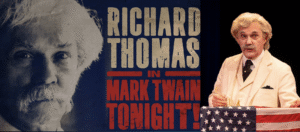
Finally, for two nights, State Theater New Jersey, located in New Brunswick, presented the delightful Richard Thomas in a production of Mark Twain Tonight. Written by the late actor Hal Holbrook, who spent more than 60 years performing the one-act play, the script, based on Mark Twain’s writings, speeches, and interviews, often varied. In the play’s programs from 1959-2017, Mr. Holbrook claimed that pinning the script down to specific selections “would cripple his inspiration.”
On at least one occasion, Mr. Holbrook included Twain’s sentiments about Jews, a mix of admiration and some prejudice, told with his customary dry wit. He praised Jews as good citizens and waxed poetic when he spoke of the Jewish home. Convinced most antisemitism was based on jealousy of Jewish success, intelligence, and talent, he joked that Theodore Herzl’s plan for a Jewish state should be opposed because it would be the site of the largest “concentration of the cunningest brains in the world.”
His only criticism of Jews was based on a stereotype that they didn’t serve in the military, an assertion for which he humorously apologized when he discovered that Jewish Americans served in the armed forces at a higher rate than their population percentage would suggest. “That slur upon the Jew cannot hold up its head in the presence of the figures of the War Department. It has done its work, and done it long and faithfully, and with high approval: it ought to be pensioned off now and retired from active service.”
Mr. Thomas, best known for playing John-Boy in the long-running TV drama, The Waltons, was superb in his portrayal of Mark Twain. His acting skills kept us engaged for the entirety of the 90-minute performance, changing characters like a chameleon, Southern-twang complementing the movements of a 70-year-old Twain, breathing life into the cantankerous, funny American genius, and retelling his stories, touring the country, as Holbrook did, bringing Twain to life. He does the memorable Holbrook proud.
Related Posts
-
 Heathers the Musical – Future Cult-Classic Takes the Theater by Storm
Posted on Sep 11, 2026
-
 All The Devils are Here – Riveting One-Man Performance by Patrick Page
Posted on Aug 27, 2026
-
 The 25th Annual Putnam County Spelling Bee – BRILLIANT and FUNNY
Posted on Aug 3, 2026
-
 The Catskills 1969 A Time of Change – Broadway Bound
Posted on May 21, 2026
Tags
Share This


