
Upgrade Your Skillet with Carbon Steel and Cast Iron
By Chef David
Is your Pesach pots and pans collection full of old, scratched, or low-cost non-stick pans? Prioritize quality and health this year. Consider purchasing skillets made of carbon steel or traditional cast iron. They are made to last, use no coatings, and are designed for high heat. If you need to select just one skillet, we recommend considering Smithey Ironware’s Carbon Steel Farmhouse Skillet. It is high-quality with a bronze sheen and a hammered handle. This elegant skillet does not look like anything you already have. You can even engrave it to add a special message, like ‘Kosher for Pesach’ or ‘Meat’, or personalize it as a gift.
These pans are beautiful and practical, made to last a lifetime.

A Perfect Pair
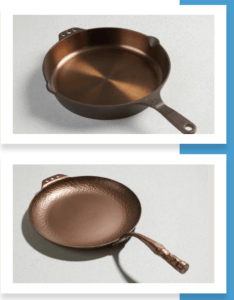
We tested the Perfect Pair, a set consisting of two skillets, the No. 12 Cast Iron Skillet and the Carbon Steel Farmhouse Skillet. This gave us exposure to their cast iron and their carbon steel offerings. We chose this option as it provides a full complement of distinctive skillets, one for milk/fish, the other for meat. They are standouts. Both are designed to withstand heat and can be used in any cooking environment, from the kitchen to campfire, and on all heat sources, gas, electric, and induction.
This set includes: a leather potholder (which can double as a trivet) and a skillet sleeve for the cast iron skillet, both branded with the distinctive Smithey logo.
Farmhouse Skillet: Material: Carbon steel
Size dimensions: 18.1in x 12in x 1.25in
Weight: Approximately 5lbs
No. 12 Cast Iron Skillet: Material: Cast iron
Size dimensions: 18.2 in x 12in x 2.2in (cooking surface 10.5 in)
Weight: Approximately 8.7lbs
The main difference is the weight (carbon steel is lighter). Neither has artificial coatings; they create a natural nonstick layer with seasoning and use. Follow the same maintenance you would for a carbon steel wok to protect the pan. After every use, dry your skillet thoroughly (don’t air dry), evaporate any leftover moisture by warming the skillet briefly on the stovetop, and then wiping it with a thin coat of oil to protect against rust.
We liked their classic design. The hammered handle on the Farmhouse Skillet is a work of art, and the curved interior is well designed for cooking. The cast-iron skillet has two pour spots and perfectly angled sides. We found both easy to use.
Smithey’s is available for purchase online. They sell a variety of sizes as well as matching glass covers.
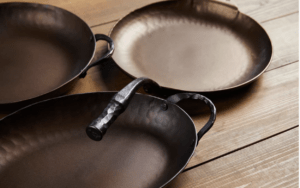
Smithey is a cookware line that honors the classic style of vintage pieces but also harnesses modern technology and processes. Smithey was created by Founder, Isaac Morton, to make a premium cast iron cookware, with a smooth surface, that is the perfect weight and dimensions. He partnered with designers, engineers, foodies, foundrymen, metal grinders, and craftsmen to produce premium cast iron and carbon steel cookware. In 2018, they launched the Carbon Steel Farmhouse Collection, made by hand by artisan blacksmiths in Charleston, SC. Each piece of the farmhouse collection is individually hand-forged and visually unique, while sharing core design features tuned to the Smithey style. Morton tells consumers to “use your Smithey to create meals and memories of your own. Don’t let your Smithey dither in a cupboard. Proudly display it on your stovetop. Put it to work! …And when it’s time to pass your Smithey to the next generation, you’ll be all the wiser.” This cookware is as beautiful as it is functional.
Myth Buster
Many people select non-stick pans believing that they are easier to maintain. We found that cast iron is not hard to clean, especially polished cast iron, which has a smooth surface. You can clean it like a normal pan with mild soap and a soft sponge. Cast iron is actually low maintenance. Because it does not have a coating, it will not wear out with use, and it becomes better with age.
Yes, cast iron can rust (especially when it is not properly dried or in a humid location), but rust can be removed by scrubbing with steel wool, a chainmail scrubber, or a coarse salt paste.
Tips
These skillets are excellent for baking. They provide great heat retention, are oven-safe, and are made for high heat, with heavy walls that distribute heat evenly. Always preheat the skillet or oven with the cast iron inside before baking.
One of the hallmarks of cast iron cookware is its density and weight, which means it naturally takes longer to heat up than thinner materials like aluminum or stainless steel. Preheat the pan on low-to-medium heat for about 5 minutes before adding any oil or food. Rushing this step can cause food to stick or brown unevenly.
Remember that cast iron stays hot well after it comes out of the oven, so let it cool before handling.
Making a Good Impression, and a Great Meal
Smithey Cast Iron Skillet and the Carbon Steel Farmhouse Skillet work well in the kitchen and look amazing on the table. We use the leather potholder as a trivet to protect the table, and the skillet sleeve to protect our hands. These skillets are designed to be workhorses, ideal for making meals that require searing to those that are baked, transferring easily from burner to stove, and then to the table for serving.
Whether you consider them for part of your Pesach collection or your everyday kitchen essentials, Smithey skillets are gift-worthy, engravable, and make a nice upgrade or addition to your kitchen collection. These modern pieces provide handcrafted elegance reminiscent of classic vintage style. Smithey skillets make a statement.

Related Posts
-
 Honey Stick for a Neat and Sweet New Year
Posted on Sep 7, 2026
-
 Designed for Kitchen Heat – ThermoWorks
Posted on Sep 3, 2026
-
 Handcrafted Wooden Toddler Spoons – Practical and Plastic-Free
Posted on Aug 21, 2026
-
 Back to Basics with Wood Kitchen Utensils – Earlywood
Posted on Jul 1, 2026
Tags
Share This


