
The Pity of It All by Amos Elon Traces German-Jewish History in das Vaterland
By Paul Rose
According to The Pity of it All by Amos Elon (Picador), in 1754, a young and poor Moses Mendlesohn arrived in Berlin and had to pass through a particular gate assigned for the admittance of those Jews with permission to stay and/or enter Berlin.
Not long before, Jews were often confined to ghettos in many towns, such as Frankfurt, and restricted in how they could trade, as many avenues were off-limits. As the 19th century progressed, the restrictions were partially lifted.
The Jews of Berlin were very keen to be fully accepted by German society. Until 1870, antisemitism was based on theological issues. If a Jew converted to Christianity, more doors, especially to academic positions and some parts of the legal professions, opened. However, such people were regarded with suspicion by a section of German society.
The nature of antisemitism also changed, shifting from Biblical grounds to racial accusations after the economic crisis of circa 1873. This was influenced by Heinrich von Treitschke, a popular historian, and Adolf Stocker, a clergyman.
The Pity of it All continues to chronicle Jewish life in Berlin up to 1914. Despite progress, professorships and civil service positions were still off limits for Jews, and during this time, intermarriage increased.
At the start of World War I, the Jews of Berlin were vociferous in their “Hate for England,” but this trend soon changed after the arrival of heavy military casualties. The Kaiser and his military establishment were not friendly to the Jewish community. In 1916, the government, believing Jews were avoiding their military obligations, organized a survey of the number of Jewish combatants serving in the armed forces. The result showed that more Jews per thousand had actively served their military duties than had the general population. These results, however, were suppressed by the authorities!
At the end of World War I, Germany entered a period of chaos and uncertainty. The Kaiser maintained that Britain had been “stabbed in the back by the Jews.” This view was promulgated by various groups of disillusioned ex-servicemen, one of whom was the-then very small Nazi Party.
In some respects, the years of the Weimar Republic proved very successful for Jewish people. Most restrictions were put aside. Jewish contribution to the arts was immense. By 1932, intermarriage had reached 40 percent.
On the political side, there were several high-profile murders, notably Kurt Eisner, the Bavarian Premier, in 1919, and Walter Rathenau, the Foreign Minister, in 1922.
The 446 pages of The Pity of it All close in 1933. The rest is a very sad history with which most readers of this book will all be too well acquainted.
Mr. Elon’s style is excellent. The book is split into ten chapters, each a lecture in its own right.
For those interested in German Jewry and its development till 1933, this will make essential reading.
An Afterthought
Over the last 40 years, I have travelled the length and breadth of East and West Germany. This includes my 20 years of commercial dealings with Germans.
As in any society, including the United Kingdom and the USA, there are different strata in Germany, and a percentage of those who are unfriendly towards Jews. I have to state right up front that my dealings in Germany have always been pleasant and correct. The German middle classes bring up their children responsibly and has a sense of decency.
Though I have visited Bergen-Belsen, Dachau, and Buchenwald, I find it hard to understand how the grandparents of these people I have enjoyed spending time with committed such atrocities.
My conclusion is that what took place in Germany 80-90 years ago could happen again elsewhere, perhaps in a different form and in a land where we would not expect such.
My motto, therefore, remains: “We must always be aware of what is happening around us and never be complacent.”
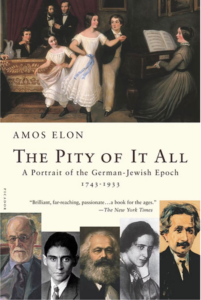
The Pity of it All
Related Posts
-
 25 Years Later – Come From Away
Posted on Sep 19, 2026
-
 A Time to Hide: Based on a True Story of Survival during the Holocaust by Marion Seidemann Fredman
Posted on Mar 2, 2026
-
 The Traitors Circle by Jonathan Freedland
Posted on Dec 2, 2025
-
 Through the Lens of his Camera – Vishniac
Posted on Apr 21, 2024
Tags
Share This


