
School Girls; Or, The African Mean Girls Play – Global Language of High School
By Sue Weston and Susie Rosenbluth, Two Sues on the Aisle
School Girls; Or, The African Mean Girls Play at the Samuel J. Friedman Theater through November 15, focuses on five girls from Aburi Girls Boarding School in central Ghana in 1986. A seemingly remote enclave, yet the girls face social challenges to fit in. They are dominated by one student, Paulina, who seems to have everything, including the ear of the Headmistress. School Girls is a light frolic back to high school, filled with petty squabbles and detention. These girls have the additional pressure of competing in the Miss Ghana Beauty Pageant and positioning Paulina for the Miss Universe competition. The arrival of a new student changes the group dynamics.
The play shows that girls will be girls, petty jealousies and competitions extend beyond ethnic and age divides. It is a comedy about cliques, secrets, and belonging.
Short Plot Summary
The pressures of high school are a universal language, providing a connection between 1986 Ghana and the audience who were eager to chuckle at the teen-clique challenges. Although the show was set in post-colonial Africa, meanness and cattiness know no bounds, extending to the Headmistress and Miss Ghana recruiter (who was Miss Ghana 1966), and an Aburi alumna.
An Outstanding Cast
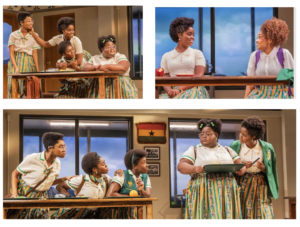
School Girls is a lighthearted comedy with exceptional performances from the entire female cast. The ‘girls’ include Ama (Lucia Aremu), Paulina’s longtime best friend, eager to leave school and wed her longtime beau. Happy to belong in the group, Mercy (Jordan Rice), whose rich father is unwilling to buy her new shoes, devotes much of her attention to her cousin Gifty (Nia Otchere-Sarfo), who can barely read. Nana (Erin Morton) is shy, kind, and overweight, making her Paulina’s prey. Nana is focused on getting into university and is glad to have recently been admitted to the group (previously, she ate lunch alone).
The group is verbally brutalized by the controlling Paulina (Denée Benton), who brags about her American relatives, her designer clothing, and her boyfriend, Kofi, a professional footballer. Paulina is the ‘queen bee’ controlling the school, under the nose of Headmistress Francis (Heather Alicia Simms), who will face her past nemesis, Eloise Amponsah (Patina Miller), recruiter for the Miss Ghana pageant.
The social order of Aburi Girls Boarding School is upset by the arrival of a new student, Ericka Boafo (Jasmine Amy Rogers) whos father is a wealthy cocoa plantation factory owner, relocating from Ohio to complete her schooling.

Conflict and Resolution
Ericka and Paulina quickly become rivals, each vying for attention and friendship from this close-knit group, both hiding secrets. Girls, especially teenage girls, are fraught with insecurities and are especially vulnerable to concerns about their body image. Paulina used this fear to maintain her power and was especially mean to Nana.
Erick, a lighter-skinned American, is open to sharing her beauty products and clothes with the others, which makes her immediately the center of attention.
School Girls was inspired by the 2011 Miss Ghana pageant. Where pageant officials selected an American-born, light-skinned biracial woman to represent Ghana at Miss Universe, passing over darker-skinned Ghanaian competitors. Author Jocelyn Bioh used this event to shape her focus on colorism, with judges favoring lighter-skinned contestants.
Our Reaction
School Girls is a relatable storyline to anyone familiar with the social structure of high school and the desire to fit in. The plot was driven by the group dynamics. While a bit more character development would have been nice, we were glad not to get bogged down in the minutiae.
School Girls; Or, The African Mean Girls Play was a fun-to-watch comedy. We thought it ended abruptly after the Miss Universe pageant. While it might have been satisfying to have closure about Ericka and Eloise, those details were left to our imagination. Sometimes less is more, and in this case, it worked.
Mean girls exist in every culture, tormenting the less popular, but they provide laughter and drama in the theater.
Two Sues on the Aisle bases its ratings on how many challahs (1-5) it pays to buy (rather than make) to see the play, show, film, or exhibit being reviewed.
School Girls; Or, The African Mean Girls Play at the Samuel J. Friedman Theater through November 15
Received a 3 Challah rating
Running Time: 90 minutes, with no intermission

Three Challahs
Related Posts
-
 Heathers the Musical – Future Cult-Classic Takes the Theater by Storm
Posted on Sep 11, 2026
-
 Laughter is the Best Medicine – The Imaginary Invalid
Posted on Aug 26, 2026
-
 Brash, Brilliant, Irreverent – Slam Frank
Posted on Jun 12, 2026
-
 Tarnished American Dream in a Brilliant Death of a Salesman
Posted on May 8, 2026
Tags
Share This


