
Playing Shylock, Playing Saul Rubinek: It’s All in the Telling
By Susie Rosenbluth
Virtually the first sentence actor Saul Rubinek said to me when we met on a Friday last November in one of the very few kosher Manhattan establishments open before an early Sabbath was: “You know I’m unabashedly self-serving.”
I wish I could tell you I thereupon jumped up in all my journalistic glory and beat it home to New Jersey in time to finish baking my challahs. But I didn’t because, truth to tell, my being there was no less self-serving than his—and at least his made sense.
A week earlier, I had reviewed his powerful performance in what was arguably the best one-man play in New York this past season. Playing Shylock, written by Mark Leiren-Young, asks the questions: Is The Merchant of Venice too antisemitic for the public at large? Is it better to ignore productions of the Shakespearean comedy—The Merchant’s traditional designation—or seek to cancel them, fearing the bad light the play casts on Jews will provoke violence?
Playing Shylock does an excellent job of proving that all it takes to humanize Shakespeare’s Jewish moneylender is to fully understand what he’s been through. The conceit of Mr. Leiren-Young’s play reflects his predilection for “mocumentaries”: an actor named Saul Rubinek has won the role of Shylock in a New York production of The Merchant of Venice, only to receive the news, just before the first intermission, that the run has been canceled. Some people, purporting to represent the “Jewish community,” have convinced the theater that this production “at this time” is not “in the best interests” of Jews.
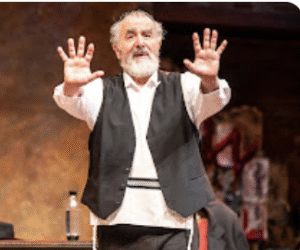
Saul Rubinek playing Shylock
“When did the culture wars turn into a circular firing squad?” the actor playing Saul Rubinek asks.
Although the play is fully scripted, it felt like Mr. Rubinek—the real actor and his on-stage doppelganger —was delivering an extemporaneous soliloquy on themes ranging from the all-too-human motivation behind Shylock’s bizarre demand for a pound of his debtor’s flesh to the actor’s crushingly enraged disappointment at being denied the opportunity to play the role his father—a Holocaust survivor and pre-war fledgling Yiddish actor—yearned to portray.
“My father’s career was also canceled—by Hitler,” he says.
Mr. Rubinek’s parents—the late Frania and Srulek Rubinek—were the real reason their son and I met for breakfast a week later. Mr. Rubinek, who in addition to working as an actor almost all his life (I remembered him best for his award-winning performance as the journalist/narrator in the 1981 Canadian film Ticket to Heaven; many others found him unforgettable as Donny, Daphne Moon’s fiancé and Niles Frasier’s matrimonial attorney, in the sit-com Frasier), is also a director and playwright. In addition, he has authored two books, So Many Miracles (Toronto: Viking, 1988) and, just last year, All in the Telling: A Somewhat True Story (Redwood). Both tell how his parents survived the Holocaust in Poland. The first is his parents’ story; the second, a first-person narrative, looks at the years before and after the war from the perspective of their son, who was born in a German DP camp in 1948.
The voice of All in the Telling’s narrator is authentic, well-matched to the veracity and structure of Mr. Rubinek’s story, which is full of twists and turns. I, however, can’t help wishing it ended differently—in no small part because, by the time I finished the book, I was in love with all the characters, especially its witty, sweet, and oh-so-vulnerable narrator. I found the way he envisioned his sister, Rachel (who and what she is would give away too much of the story), irresistible. She could have been me.
All this means that Mr. Rubinek’s scheduled performance on March 25 at The Museum of Jewish Heritage in Lower Manhattan should prove memorable. He will read from All in the Telling; show clips from his documentary film, So Many Miracles, about his 1986 trip with his parents to Poland to reunite with the farmers who hid them for two and a half years during the Holocaust; and hold a discussion with Professor Annette Insdorf, who teaches film at Columbia.
I have no idea if he will recount his discussion with me.
After my review of Playing Shylock was published in my own TheJewishVoiceAndOpinion.com as well as several other member publications of the American Jewish Press Association, Mr. Rubinek asked me to review All in the Telling. He did more than ask. Noting that my own novel, Blurred Vision, was about to be launched by Red Adept Publishing, he offered to read it, write a blurb if he liked it, and, perhaps, pass it around to some of his friends in California, where the Canadian-raised actor now lives. Names such as Alan Alda and Judd Hirsch, who had each written blurbs for All in the Telling, were mentioned.
When I eagerly sent for his book, I didn’t say anything to Mr. Rubinek about my being self-serving.
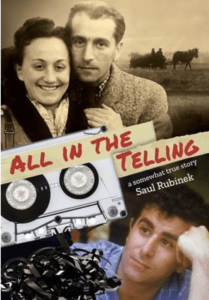
All in the Telling
In fact, I expected to love All in the Telling as much as I did Playing Shylock. For one thing, I approach all Holocaust survival stories with a feeling of reverence. My own immediate family—all the aunts, uncles, parents, grandparents, and great-grandparents of my childhood—arrived in the United States more than twenty years before Hitler came to power, but, like all Jewish Americans raised in the mid- to late-twentieth century, World War II is still an ever-present hovering atua, an abiding shadow always looming on the not-so-distant horizon.
While most Holocaust remembrances include horrific flashbacks, the stuff of nightmares, they usually end on notes that exude something greater than hope, bordering on triumph. Despite it all, we’re still here. Am Yisrael Chai.
Some of these remembrances touch on intermarriage—most of them from before and during the war, a few between Jewish female survivors and Allied soldiers—but they usually detail the Jewish lives rebuilt on the ashes, often with ties to Israel.
In Playing Shylock, the issue of the intermarriage between the moneylender’s daughter, Jessica, and one of Venice’s antisemitic Christian ruffians is obviously among the explanations for Shylock’s rage. As far as I’m concerned, Jessica is the chief villainess of the story; however, intermarriage is not a major theme of either The Merchant or Playing Shylock.
Not so All in the Telling. Although Mr. Rubinek reacted with horror when I told him his book was essentially about the intermarriage of the only son of two Holocaust survivors, there is no denying that the memoir not only begins with his relationship with a Gentile woman, and ends with his marriage to another one.
In fact, the raison d’être of the whole book concerns the convoluted—but cleverly relatable—manner in which he tells his parents “the truth.” After putting off allowing his then-live-in girlfriend, Kate, to meet Frania and Srulek, Saul finally goes by himself to Canada to break the news. While not religious, his mother weeps, and his father literally pours ashes on his head. From an ashtray. In the narrative, it’s hard to tell if the author is simply, like a journalist, reporting what happened or if he thinks it’s funny.
“They looked at me like someone they don’t understand, don’t recognize, don’t even like. Who does not honor his parents, the way they honored their parents? Their murdered parents.”
Then his parents stop talking to him.
Saul’s sister, Rachel, offers him an idea: “What’s the one thing Mom and Dad can never say no to you about?”
“Food?” Saul suggests.
“Idiot,” she responds. “Your career.”
So, Saul lies to his parents—not about Kate. He tells them he received a call from a major Canadian publishing house asking him to write his parents’ Holocaust memoir. The falsehood goes even further. The publisher, he tells them, is going to give him a major advance before he produces even one word.
The book, which he does write—presumably So Many Miracles—brings him closer to his parents and their story. They do not accept his relationship with Kate, and for reasons that may—or may not—have anything to do with Frania and Srulek, Saul and his girlfriend part.
But by the end of the book, he has met another Gentile girl, very beautiful, kind, intelligent Elinor, who, according to All in the Telling, his parents like so much they’re surprised she wants to marry their son. But that doesn’t prevent Frania from trying—unsuccessfully—to persuade Elinor to convert. Nevertheless, Saul tells us, his and Elinor’s parents dance at their wedding, presided over by a rabbi who officiates at intermarriages, and the two Holocaust survivors fall in love with their halachically non-Jewish grandchildren, breathtakingly beautiful Hannah and Sam, whose photographs are among many others in the book.
Srulek, however, informs his fellow congregants at shul that Elinor did convert—just one more self-serving lie.
There are many reasons to cry during and after reading All in the Telling. The senior Rubineks’ experiences are heart-wrenching, and the legacy left to Saul of nightmares and the yearning for a sibling is an experience shared by many second-generation survivors. It is a very well-written book by a talented artist who has and appreciates the gift of storytelling.
But it’s not so easy for those of us, whether religious or not, who grew up taking Holocaust theologian Emil Fackenheim’s 614th commandment seriously —that after Auschwitz, it is forbidden to hand Hitler yet another posthumous victory by “letting the Jewish people perish.” For us, this means an imperative to do whatever is possible to dissuade Jews from intermarrying, at least without the benefit of conversion. After conversion, it is no longer an intermarriage.
Obviously, if this were ever honored, it is now done so in the breach. A 2020 Pew study showed that 61 percent of American Jews who married between 2010 and 2020 did so with a non-Jewish partner. And since then, the numbers have only risen. Overall, close to 50 percent of American Jews are now married to non-Jews. Baruch Hashem, in the Orthodox community, the number is less than two percent—horrible for those families facing it, but statistically insignificant.
Unfortunately, for my agreement with Mr. Rubinek to review his book, it is the Orthodox community, ranging from Modern Orthodox to much more traditional, for whom I write. I can’t in good conscience recommend All in the Telling to them as anything more than an interesting, witty, often eloquent slice of history. It tells the story of a couple who did everything they could to survive as Jews—the book written by their son proves it—but whose legacy, angry as it will make Mr. Rubinek hear, is a Jewish communal tragedy that reduces me to tears.
I don’t think this is the review Mr. Rubinek was hoping for when both of us showed up for that meeting last November. I wish I could have written more about him as an actor, one I’d pay good money to see play anything but especially Shylock. It would be a masterful portrayal based on a thorough understanding of the character and the environment in which he lived. I’m thrilled to say, although Messrs. Alda and Hirsch were never mentioned to me again, Mr. Rubinek already gave me a very kind and mind-blowingly impressive blurb for Blurred Vision, which, self-serving as I am, I hope he won’t now rescind.
Related Posts
-
 A Time to Hide: Based on a True Story of Survival during the Holocaust by Marion Seidemann Fredman
Posted on Mar 2, 2026
-
 Three One-Man Plays, Three Questions: Does Shylock Trigger Antisemitism or Expose It? Is Hannah Senesh More Myth Than History? Why Not Include Mark Twain’s Views on the Jews?
Posted on Nov 12, 2025
-
 See, Hear, and Feel the Words of Elie Wiesel — Elie Wiesel: Soul on Fire
Posted on Sep 2, 2025
-
 Amsterdam Apology—Hollow Rhetoric?
Posted on May 9, 2025
Tags
Share This


