
Hannah Senesh – A Light in a Period of Darkness
By Two Sues on the Aisle, Susie Rosenbluth and Sue Weston
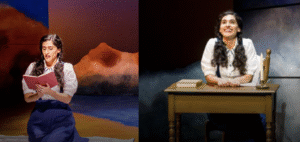
In October, we attended the National Yiddish Theater Folksbiene performance of Hannah Senesh, a one-woman historical fiction, based on the words of a young girl (played by the talented Jennifer Apple). The production directed by playwright David Schechter reminds us how youthful exuberance can spark hope even in the darkest times.
The message is as timely today as it was when it was first performed in 1984.
Hannah-Anna (Aniko) Szenes was born in 1921 in Budapest into an assimilated family. Her father was a journalist, author, and playwright who passed away when Hannah was six years old, leaving a wife, Catherine, and two children, Aniko and her brother Giora. At the age of 18, Hannah immigrated to Palestine, where she studied at an agricultural college and worked on a kibbutz. Determined to do something about the horrors of the Holocaust, she enlisted as a British paratrooper to rescue British soldiers caught behind enemy lines in Yugoslavia. She planned to cross into Hungary to help Jews in her homeland escape. Hours after crossing the Hungarian border, she was apprehended, caught in possession of a transmitter. After refusing to share the radio codes, she was tried for treason. At the trial, she expressed her Jewish faith, and on 7 November 1944, she was executed by firing squad. She was only 23 years old.

Telling Her Story
Playwright David Schechter portrays Hannah as “an ordinary person who became extraordinary when the times demanded it.” Her diary contains entries about the mundane experiences of a young girl, like attending a dance where she knew no one. She was a studious girl who may have created the persona of Hannah to give herself courage. While Hannah’s heroism makes an impact, it is her poetry, journal entries, and singing that show her vulnerable, human side. Hannah was impulsive, acting out of the conviction that she could make a difference.
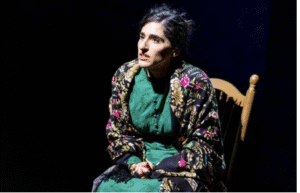
Schechter focuses on the relationship between Hannah and her mother (both parts played perfectly by Apple), bookending the performance with Catherine offering a mother’s perspective, heartfelt, endearing, with a heartbreaking ending. Catherine recalls with pride how Hannah held letters by the window of her prison cell to communicate with other prisoners and stood up to the Gestapo. She explains that Hannah’s “suicide” mission brought hope, noting that Hannah was buried in the martyrs’ section of the cemetery.
The show ends with Catherine reciting the words, “There are stars whose radiance is visible on Earth though they have long been extinct. There are people whose brilliance continues to light the world, though they are no longer among the living. And when the night is especially dark, these lights burn the brightest. They help to light the way.”
This is a Hannah Senesh Moment
Hannah Senesh is a tribute to one woman’s commitment to building a Jewish homeland. A woman who chose to leave the safety of her home in Palestine to protect those still in Budapest. We watch as she matures into a purposeful young woman filled with passion and a belief in humanity. She composed poetry, including “Eli, Eli,” a statement of faith, a prayer for the continuation of nature, and human hope, which we sing today.
O Lord my God, I pray that these things never end. The sand and the sea. The rush of the waters. The crash of the heavens. The prayer of man.
The National Yiddish Theatre Folksbiene presentation of Hannah Senesh ended on November 9, but the message is clear: we need to have faith, embrace our Jewish heritage, and our right to a Jewish homeland.
Especially now, when antisemitism is reaching epic proportions globally, it is essential to share inspirational stories like Hannah Senesh and to act to protect our right to live as Jews.

Related Posts
-
 “Eureka Day”: What If the People with Whom You Passionately Disagree Are Not Villains?
Posted on Feb 27, 2026
-
 The 25th Annual Putnam County Spelling Bee – BRILLIANT and FUNNY
Posted on Jan 10, 2026
-
 Amaze Magic – Designed to Delight
Posted on Nov 18, 2025
-
 Three One-Man Plays, Three Questions: Does Shylock Trigger Antisemitism or Expose It? Is Hannah Senesh More Myth Than History? Why Not Include Mark Twain’s Views on the Jews?
Posted on Nov 12, 2025
Tags
Share This


