
Fighting Iranian Oppression – Tatami the Movie
By Two Sues on the Aisle, Susie Rosenbluth and Sue Weston
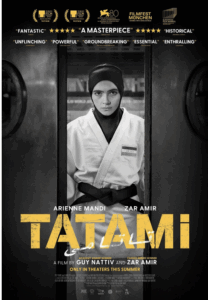
Tatami is the first feature film to be co-directed by Iranian and Israeli filmmakers, Zar Amir and Guy Nattiv, which makes their backstory as amazing as the film. They expose the control exerted by the Iranian government (which denies Israel’s right to exist), impacting Iranian athletes and artists globally. The movie takes place at the World Judo Championship (WJC), where Leila, an Iranian Judoka, is pressured to drop out of the competition to prevent Iranian and Israeli athletes from competing against each other after demands from the Islamic Republic of Iran.
Leila faces an impossible choice: submit to the Iranian regime or go for the gold.

Making an Important Statement
The Iranian government exerts its power to prevent Iranians and Israelis from meeting at international events. Tatami is a testament to the strength of athletes and artists who have chosen to pursue their aspirations, forcing many to leave their place of birth, families, and friends behind.
Standing up to a bully on a global stage requires an incredible amount of courage. Tamari shows the world what it looks like to stand up against oppression.
Inspired by True Stories
Iranian athletes are frequently forced to choose their country over their profession. Imagine training your entire life to be the best, and when the opportunity to win is within reach, an athlete can be ordered to withdraw from competition, and is expected to obey.
This decision, which seems black-and-white, is nuanced with levels of complexity. The film, Tatami, is shot in black and white, a paradox suggesting a strong connection to an antiquated time.
While Tatami is not based on a true story, it was inspired by judoka Saeid Mollaei, who was ordered to lose bouts to avoid competing against Israeli judo champion Sagi Muki at the 2019 World Championships in Tokyo. Mollaei fled to Europe, where he was granted refugee status in Germany. Saeid is not the only Iranian athlete who defied the government. Sadaf Khadem, a female boxer, defected to France. Rock climber Elnaz Rekabi competed without her hijab, and Kimia Alizadeh, who fenced during the Rio Olympics, defected with her husband.
These stories have been overlooked by the media. While the bravest athletes have been able to defect, many others gave in to the threats to protect their loved ones.
Showing Athletes Reality
The movie shares how Judoka Leila (American-Iranian TV actress Arienne Mandi) and her family are affected by Iranian restrictions. She must get her husband’s permission to travel to the WJC, receiving a late-night, last-minute phone call, telling her she would be leaving early the next morning. Leila hushes her husband, who is openly resentful of the government’s interference in their lives. A flashback shows them attending a private club, where they dance freely, full of life, and she is not wearing a head covering. This parallels her decision to remove her headscarf in the competition, signaling her determination to compete and win at all costs.
Laila is fortunate to have the support of her family and friends. But her decision to go for gold puts them at risk. The Iranian government uses them to influence her behavior, kidnapping her parents, holding them as collateral. Her husband and son are forced to flee from Iran on foot.
These intimidation tactics had worked on her coach, Maryam (Zar Amir), a talented judoka, who was forced to fake a career-ending injury at the Tokyo Olympics.

Suspense and Terror
The film is a rollercoaster ride that plays out over the course of one day. It begins with Leila exchanging pleasantries with an Israeli competitor, as her teammates and coach look on with disgust. As the competition progresses, Leila slowly and steadily advances, struggling to beat the odds. She displays unwavering focus and determination.
Initially, her coach yells encouragement to her from the sidelines. At home, her family and friends cheer each victory.
Everything changes after her coach receives a threatening call from the Iranian minister of sports, instructing Leila to pull out of the tournament, eliminating any possibility she could face an Israeli player in the finals.
The tension mounts as Leila struggles against improbable odds on the mat, managing to best each competitor, pushing through the pain to advance. She finds herself alone as her coach and country turn against her. Even the WJC turns a blind eye to the political drama playing out behind the scenes.
Fighting Oppression
Tatami shows the determination of the strong women who risked everything to defy a system that ignores their rights. This movie focuses on the often-invisible strong hand of oppressive governments, contrasting it with Judo, a sport that relies on strategy, willpower, and finesse to flip opponents, forcing them into submission.
The movie pushes boundaries, showing one woman’s silent fight for freedom. It is a reminder of the importance of trust, justice, and the need to find the truth. Tatami gives a face to sportsmanship and compassion. It is nail-biting good, with a satisfying end leaving us with hope.
Two Sues on the Aisle bases its ratings on how many challahs (1-5) it pays to buy (rather than make) to see the play, show, film, book, or exhibit being reviewed.
Tatami Received 5 Challahs
RUN TIME: 105 Minutes

Five Challah Rating
Related Posts
-
 Shocking and Terrifying True Story – Kidnapped: The Abduction of Edgardo Mortara
Posted on Feb 24, 2026
-
 The Road Between Us: The Ultimate Rescue – A Documentary of Epic Proportions
Posted on Oct 21, 2025
-
 A Dark Comedy – Bad Shabbos – Tells A Good Story
Posted on Oct 1, 2025
-
 Gene Wilder Remembers Gilda – At The George Street Playhouse
Posted on Aug 9, 2025
Tags
Share This


