
A Time to Hide: Based on a True Story of Survival during the Holocaust by Marion Seidemann Fredman
Reviewed by Susan L. Rosenbluth
Every Holocaust remembrance is important, but Marion Seidemann Fredman’s A Time to Hide (The Collective Book Studio) is one the reader could imagine listening to while the author pours tea before she takes out her family album.
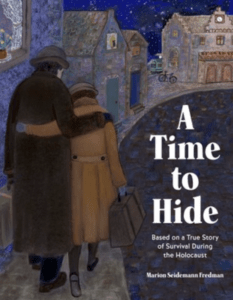
Though it’s written as a picture book for children ages 9-12, their elders will find A Time to Hide equally compelling. In simple language, illustrated with a combination of historical photographs of the characters who populate the story, some of the important documents that figure in it, and evocative drawings by Elisa Kleven, Diane Dove, and Mrs. Fredman’s daughter, Juliana, to fill in the gaps, the book tells the powerful true story of an ordinary family living through—and surviving—one of the darkest periods in modern history.
Over the years, volumes have been devoted to the villains of the Holocaust—the Nazis and their cohorts whose unspeakable crimes still baffle sociologists and psychologists; monsters who denounced Jews, including children, for the sheer pleasure of it; those who stole Jewish belongings as soon as possible (sometimes before their rightful owners were even taken away), and so forth ad nauseum. Mrs. Fredman singles out Hitler and the Nazis, of course, detailing their cruelties, major and minor, leveled against the Jews, but she glosses over many of the others, such as the typical Germans living cheek-to-jowl with their Jewish neighbors in Bochum, the North-Rhine Westphalia German city her mother, Grete Benjamin, called home.
As Mrs. Fredman tells us: “When Grete and her Jewish friends were no longer allowed to go to the theater, their non-Jewish friends and colleagues watched—maybe they were sad or angry, but they said and did nothing.”
On Rosh Hashana 1937, when Miss Benjamin was 26, she met Julius Seidmann, a prosperous businessman ten years her senior. Five weeks later, they were married. A year later, they fled Germany, hoping to avoid Nazi rule by relocating to Holland.
They were not the only ones. Other members of their family found different places to go—and some, like Grete’s widowed mother (Mrs. Fredman’s grandmother), Cilly, simply refused to leave and were never heard from again.
Mrs. Fredman is especially good at showing how the specter of the Nazis followed the Jews—and how decent non-Jews did whatever possible to help these innocents who were being persecuted. According to Mrs. Fredman, in Velp, Holland, Grete and Julius “became close to their neighbors, who soon felt like family to them.”
But when the Nazis invaded Holland, Mrs. Fredman tells her readers, many throughout conquered Europe “thought the German occupation would be temporary, so they needn’t worry.”
“Some Dutch people were angry and spoke out,” she writes. “There were even those who supported the Nazis. Grete and Julius felt like they were reliving the same nightmare they left Germany to avoid.”
On a cold winter night in 1942, the couple tore off their yellow stars, boarded a train, and disappeared to Apeldoorn, some 19 miles from Velp. There, two sisters, devout Christian missionaries, had been asked by their church to shelter Grete and Julius—and they agreed.
For two years, the couple hid in the sisters’ attic in conditions familiar to anyone who has read Anne Frank’s diary. Things grew much more complicated when Grete became pregnant. Although Mrs. Fredman does not so much as mention the word “abortion,” Greta says, “I can’t have a baby. I have no home, no passport, no country. I’m stateless. I have no right to bring a baby into this world.”
The non-Jewish doctor, brought to her by the Dutch Underground Resistance and the sisters, disagreed with Greta’s assessment that “having a baby in this situation was impossible.”
After reminding her of what the Nazis were doing to “your people,” he says, “Bringing a new Jewish life into the world is the greatest act of resistance against what the Nazis are doing. It is also the only hope for your people.”
Which is why, on March 10, 1945, under circumstances that can be described only as an even mix of miraculous and ludicrous, their daughter, the author of A Time to Hide, was born. Sixteen days later, Nazi soldiers pounded on the sisters’ door, “demanding to be let in to check if there were any Jews living there.”
Another miracle saved them—this one credited by Grete and Julius to the Nazis’ dog.
A month later, Apeldoorn was liberated.
The rest of the story—how the family left Holland for the United States, where they reunited with several members of their family, all of them rebuilding their lives, but continued searching for what happened to so many others—is told so well and illustrated so joyously that it doesn’t feel anticlimactic at all.
A Time to Hide is an important addition to any family’s library in no small measure because of Mrs. Fredman’s refusal to overlook the goodness of the many non-Jews who overcame the natural tendency to shrink in fear in the face of appalling danger. The evil displayed by the Nazis—and their spiritual descendants today—is often unfathomable. Terror is an emotion only the most callous can claim not to understand. Rising above it to enact good is what we should study—how to do it ourselves and, perhaps more important, how to teach our children to emulate those who show such courage.
Related Posts
-
 Conservatives Must Draw a Bright Line against Bigotry and Extremists
Posted on Dec 29, 2025
-
 The Traitors Circle by Jonathan Freedland
Posted on Dec 2, 2025
-
 An Attack 1500 Years in the Making
Posted on Oct 27, 2025
-
 Inner Strength and the Power of Words- There Was a Time for Such a Word
Posted on Oct 19, 2025
Tags
Share This


