
Elegant Kippot – Rubinstein Paris
By The Jewish Voice And Opinion Staff
What you wear affects how you view yourself. The concept called ‘enclothed cognition’ suggests that wearing fancy, well-made items can spike confidence and boost self-esteem. It follows that a yarmulka should be fashionable, as well as a sign of reverence, respect, and refinement. This was the vision behind Rubinstein Paris, a new luxury brand elevating kippot into a quality fashion piece.

Rubinstein Paris, launched in 2026, by Jonathan Hirsch, a 29 years old German Israeli who is based in Berlin. The name Rubinstein is a play on Hirsch’s middle name, Reuven.
Frustrated by the low quality and uninspired design of standard mass-produced kippot, Rubinstein Paris provides options, creating a new market for modern, fashionable, high-end kippot
The Rubinstein Paris Difference
The Rubinstein kippot are designed to be a luxury purchase, replicating the prestige once associated with Tiffany. Everything is elegant, beginning with the distinctive blue box which slides out to reveal a string bag protecting the kippot. Rubinstein kippot come with a certificate of authenticity, creating future value. Their craftsmanship positions Rubinstein as a future collectable.

Kippot are released as curated, scheduled, limited-run collections. They currently offer eight styles with a limited number of colors and two sizes. Small (17 cm / 6.7 in circumference) — a more fitted, refined silhouette, and medium (20 cm / 7.9 in circumference) — a slightly fuller, classic fit.
- The Naftali reimagined and elevated version of the knitted kippa (available in black, ivory, and green)
- The Zevulun, contoured corduroy (available in ivory, golden brown, and navy)
- The Yehuda (a crushed velvet) (gold and black)
- The Avraham (stylized velvet kippa), which comes in black, golden brown, and ivory
- The Gad is similar to Yehudah in material but a little more shaggy dog (gold and black)
- The Moshe black (contoured traditional)
- The Ephraim with a rich traditional look (navy and black)
- The Shlomo is similar to the Zevulun, with thinner lines (blue and grey)

The Gad and Zevulun
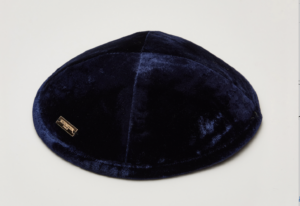
These kippot are designed with specific contours, shaped to fit the head and retain their form, more rigid than the traditional cloth kippah, and more exciting than the mass-produced leather, velvet, or cloth. They are structurally distinct, made of rich fabrics (including ribbed velvet and corduroy). They have weight and body, with specialized piping across the bottom, giving them a contoured fit.
Their exterior hides the true grandeur of these kippot, the inner linings which are works of art, depicting traditional themes in vibrant colors. The signature lining was inspired by the iconic silk carrés of Hermès but reimagined through a distinctly Jewish lens. The artwork celebrates Jewish heritage and tradition, each with a different fragment of the larger illustration. We wish they produced a kippah showcasing these fun scenes, but that would defeat the concept of a refined, elegant yarmulka.
Rubinstein is simple but elegant, distinguished, professional on the outside, with extravagant artwork inside.

Our Experience
Our team enjoyed wearing the Rubinstein Paris kippah. Just like any high-quality designer item, it is well designed, understated, and elegant. You can recognize a Rubinstein by its shape, material, and a small metal name tag. We noticed a few walking down the streets of Manhattan.
According to Hirsch, ‘For many Jewish men, the kippah is the most meaningful garment they wear. It’s a symbol of faith, identity, and tradition. Yet despite its significance, it’s often the piece that receives the least attention. People invest in beautifully tailored clothing, quality shoes, and fine watches, but many still wear the same kippah they’ve had for years or one they happened to pick up along the way. I felt that such a meaningful item deserved the same level of design, craftsmanship, and care as the rest of a person’s wardrobe.’ We agree with the sentiment.
Rubinstein Paris is envisioned as a traditional fashion house, selling collections rather than personalized products. They plan to introduce new materials, colors, and designs like other luxury fashion brands. Their kippot are pieces of art, with fine craftsmanship and attention to detail. Each Rubinstein comes with an authenticity card featuring certifying that the piece is an original Rubinstein creation.
The Evolution of the Requirement to Cover Your Head
The requirement for men to cover their heads in public evolved. The first mention in the Talmud was for scholars to cover their heads to show reverence, acknowledging that a higher power is always above them. It was years later, in the 16th Century, that the Shulchan Aruch stated that men should cover their heads to walk more than four cubits (about 6 feet) or make a blessing. Through the 1940s, men wore hats (like bowler hats or fedoras), hoods, or caps.
Wearing a yarmulka in public became part of the 1950s culture change. Post World War II, in Israel, Religious Zionists wore the Kippah Serugah (the crocheted kippah) to distinguish themselves from both secular Israelis and the old-world Europeans. It was lightweight, colorful, and designed specifically to be worn outdoors.
In American culture during the 60s and 70s, Jewish college students began wearing their yarmulkes as an expression of ethnic pride inspired by the “Black is Beautiful” movement. This feeling of Jewish pride was compounded by Israel’s victory during the 1967 Six-Day War. By the 1980s, wearing a kippa in public was normalized, and by the 1990s, it became fashionable to wear a kippa with logos of sports teams or other branding.
Make Your Statement with Rubeistein
Wearing a kippa in public is making a statement. It is an acknowledgement of being an observant Jew. A kippa does not need to be a billboard, or make a political or social statement, or be a memory of a recent simcha. Wearing a kippa is a sign of respect, and it feels right to have a yarmulka that is elegant and well-crafted, especially on Shabbos and Yom Tov. Your yarmulka completes the ensemble, like wearing Shabbos clothes or a fancy watch to shul. Rubinstein Paris kippa is simple, elegant, and well-made, dignified on the outside, hiding its signature lining.
Related Posts
-
 Grounds for Sculpture – New Instillation Invites Viewers to Contemplate the Multifaceted Nature of Time
Posted on Sep 23, 2026
-
 Birthright Israel Announces Inaugural Global Business Summit, Bringing 350 of the World’s Leading Philanthropists and Business Leaders to Tel Aviv This November
Posted on Sep 9, 2026
-
 Does Jewish Existence Conflict with Human Survival?
Posted on Sep 1, 2026
-
Seeking Justice for Black and Jewish Slave Artists
Posted on Jun 21, 2026
Tags
Share This


